Almost a third of open referrals on the NHS Community Health Services waiting list for adult weight management and obesity have been open for more than a year, according to NHS England's February 2026 return. The list is small (5,930 open referrals nationally, sourced from CSDS) and this piece signposts what the data does and does not cover: it is not the RTT list quoted by the BMA, and it excludes tier 3 and tier 4 specialist care, the NHS Digital Weight Management Programme, and the NHS and private GLP-1 markets. Within that narrow scope, the queue is ageing sharply and provision is concentrated in one region.
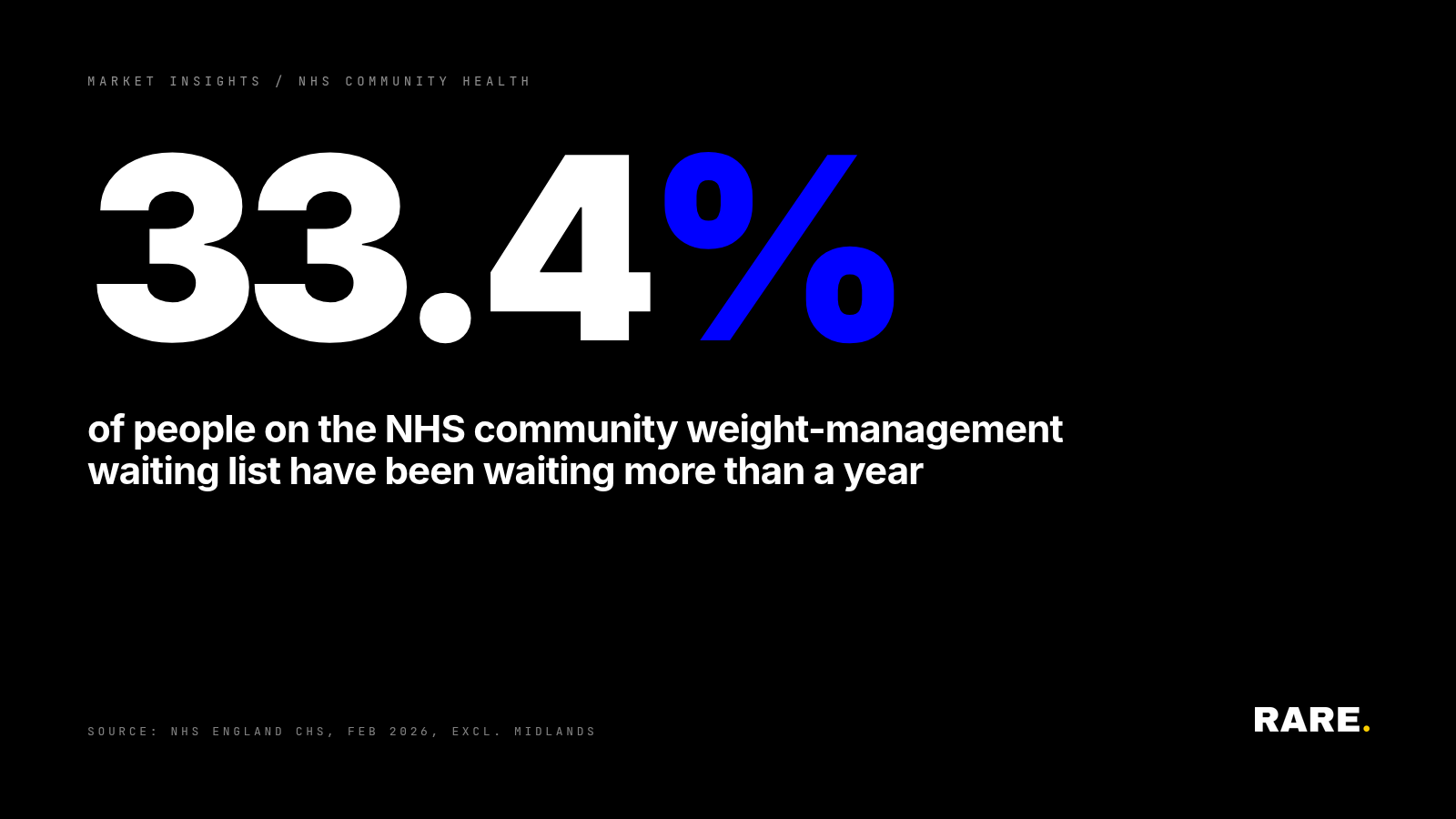
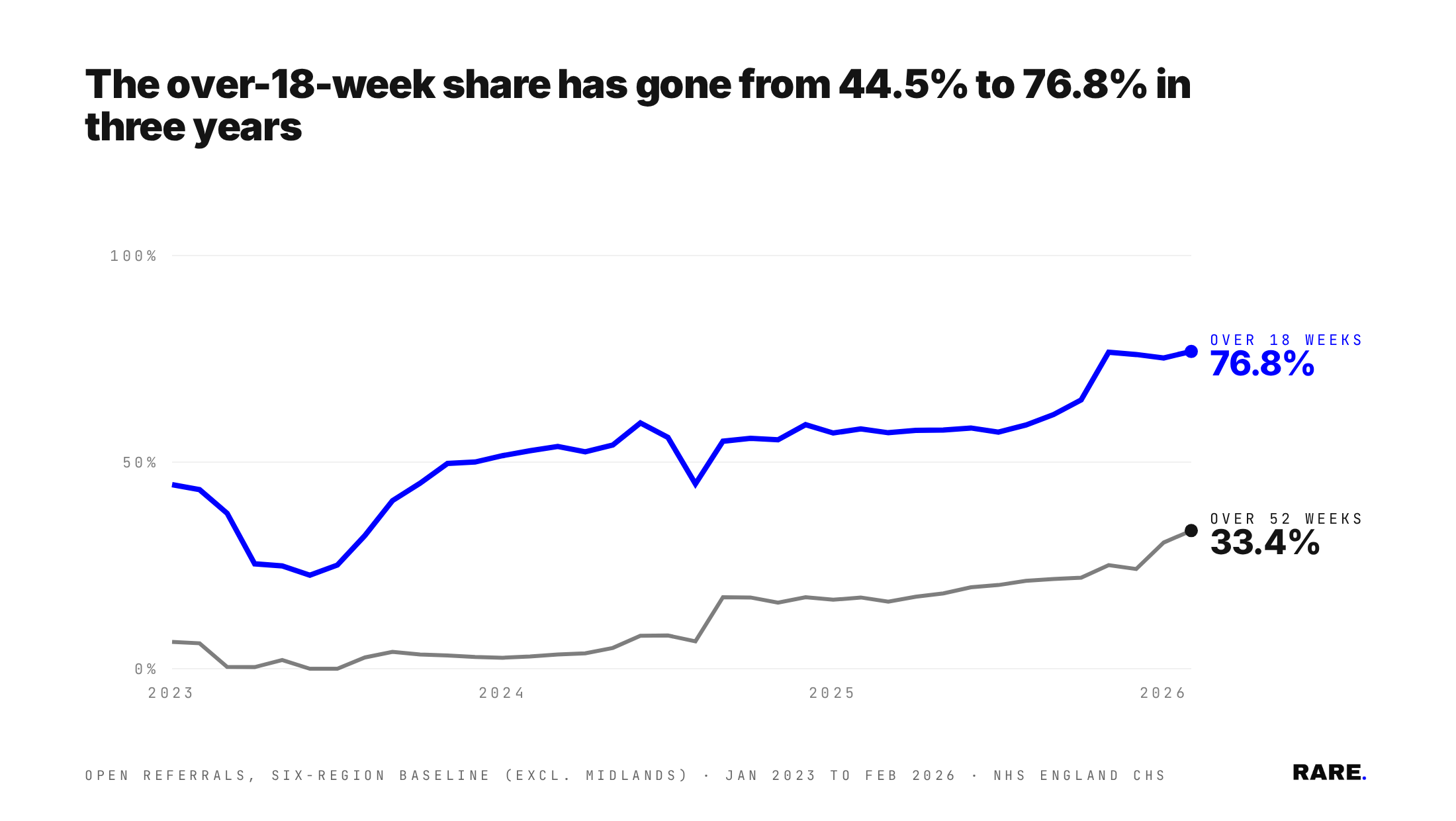
In February 2026, the NHS Community Health Services waiting list for adult weight management and obesity recorded 5,930 open referrals across England, 5,730 of them on the six regions that have reported consistently through the series. On that six-region baseline, a third of those cases (33.4%) have been open more than a year and more than three quarters (76.8%) more than 18 weeks. 117 cases had been open more than two years. Three years ago, the over-52-week share was 6.5%.
The recorded list is small in absolute terms, and it has not been growing. But the share of cases waiting beyond standard NHS reporting bands has climbed sharply, provision is effectively absent in two regions, and one region carries nearly three-quarters of the referrals on the list nationally.
The list is not growing. The wait is.
What does the NHS community weight-management waiting list actually cover?
This piece looks at one narrow, publicly reported window on NHS weight-management activity: the Adult Weight Management and Obesity Services line in the NHS Community Health Services (CHS) waiting list, published monthly by NHS England from the Community Services Data Set (CSDS). The dataset covers NHS-commissioned tier 2 and tier 3 community weight-management provision. Tier 2 is the lightest-touch intervention, typically 12 weeks of group lifestyle support. Tier 3 is the multi-disciplinary specialist community service. The two report to CSDS together and are not separated in the published statistics. The unit is open referrals, not unique individuals. One person referred more than once, or to more than one community service, appears more than once. There is no published unique-patient denominator at service level.
The CHS list is not the same list as the one that carries the widely quoted 7.28 million cases (BMA, May 2026). That number is Referral to Treatment (RTT): elective, consultant-led, secondary-care pathways. The community weight-management list is a separate return, alongside RTT, not inside it.
The 5,930 open referrals reported in February 2026 also sit outside the following, which together account for almost all NHS and non-NHS activity for people seeking help with their weight:
The population living with obesity in England (approximately 14 million adults with a BMI of 30 or above per the Health Survey for England 2024, of whom an estimated 1.5 million are at BMI 40 or above, the severe-obesity threshold NICE uses to gate specialist intervention. The shape of that burden across regions and deprivation deciles is covered in a separate Rare.Monitor analysis.)
The NHS Digital Weight Management Programme (a separate national programme launched in 2021, not reported through CSDS).
Tier 3 provision delivered in secondary-care consultant-led settings (these pathways report through RTT, not CSDS; community-based tier 3 that reports through CSDS is inside the 5,930, alongside tier 2).
Tier 4 bariatric surgery pathways (small headcount, long waits, reported through RTT).
NHS specialist GLP-1 prescriptions (Wegovy under NICE TA875 and Mounjaro under phased rollout, rate-limited by service capacity rather than published as a waiting list).
The private GLP-1 market (Mounjaro, Wegovy and off-label semaglutide prescribed outside the NHS, estimated in the hundreds of thousands of users in the UK).
The 5,930 is therefore the narrowest, most tightly scoped visible slice: one monthly return on the community-tier weight-management pathway, covering tier 2 and community tier 3 together. It is not a proxy for total demand for weight-management support in England. What it is useful for is a look at how that specific reported window is coping. On that measure, the reading is unambiguous.
How long are cases waiting?
NHS England's community health services return for February 2026 records 5,930 open referrals on the Adult Weight Management and Obesity Services waiting list. On the six regions that have reported consistently through the series (all English regions excluding Midlands), 76.8% of those cases had been open more than 18 weeks, and 33.4% more than 52 weeks. The 18-week band is the reporting benchmark NHS England publishes community services against, not a statutory community target. Across all seven regions including the current Midlands return, the equivalent figures are 74.6% and 32.3%; the Midlands number since September 2025 reflects the reporting change flagged below and pulls both national shares down. 117 cases had been open more than two years.
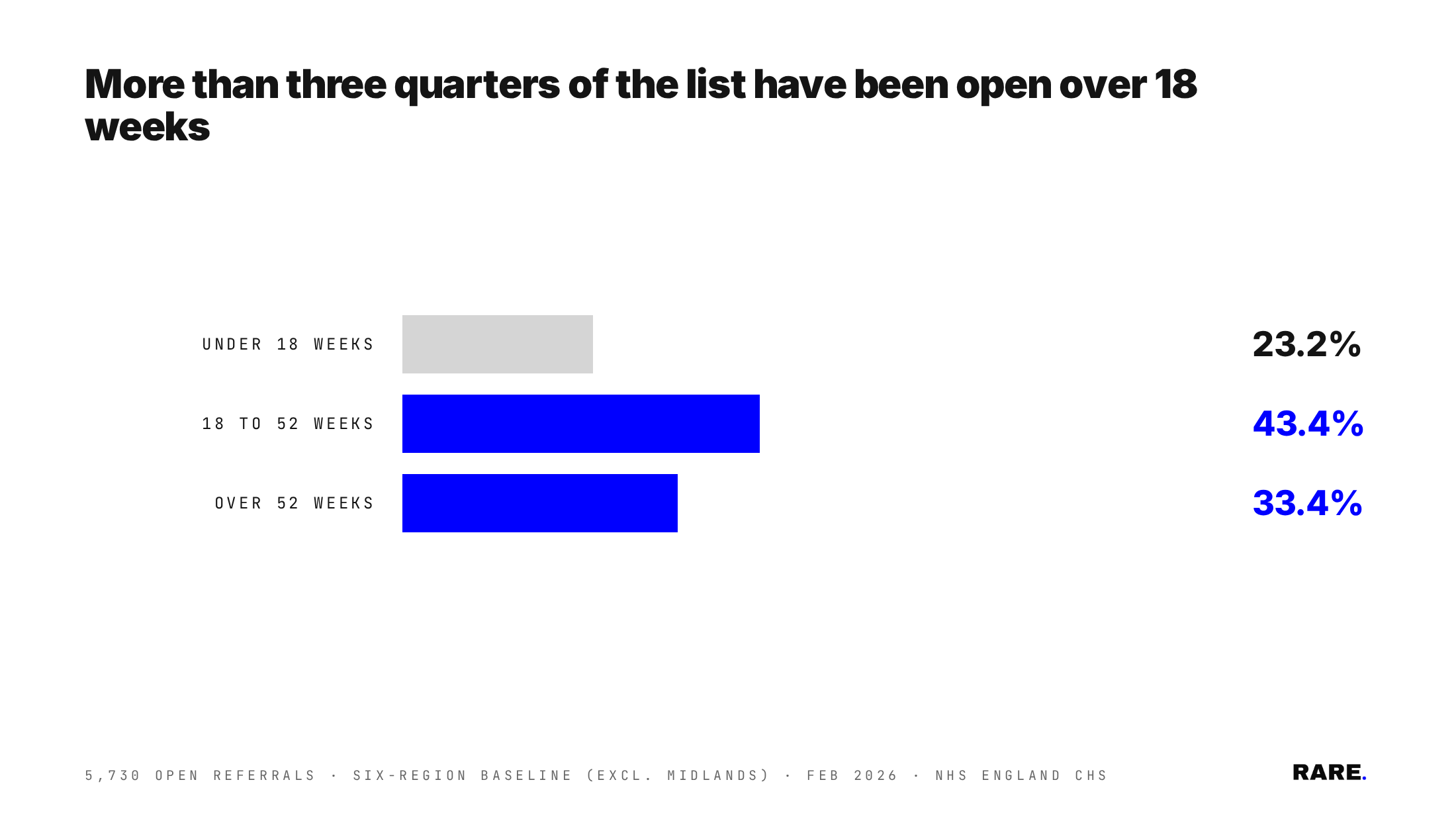
Roughly a quarter of the six-region baseline had been open under 18 weeks. The remaining three quarters were concentrated in long-wait bands, with 18 to 52 weeks the largest single group.
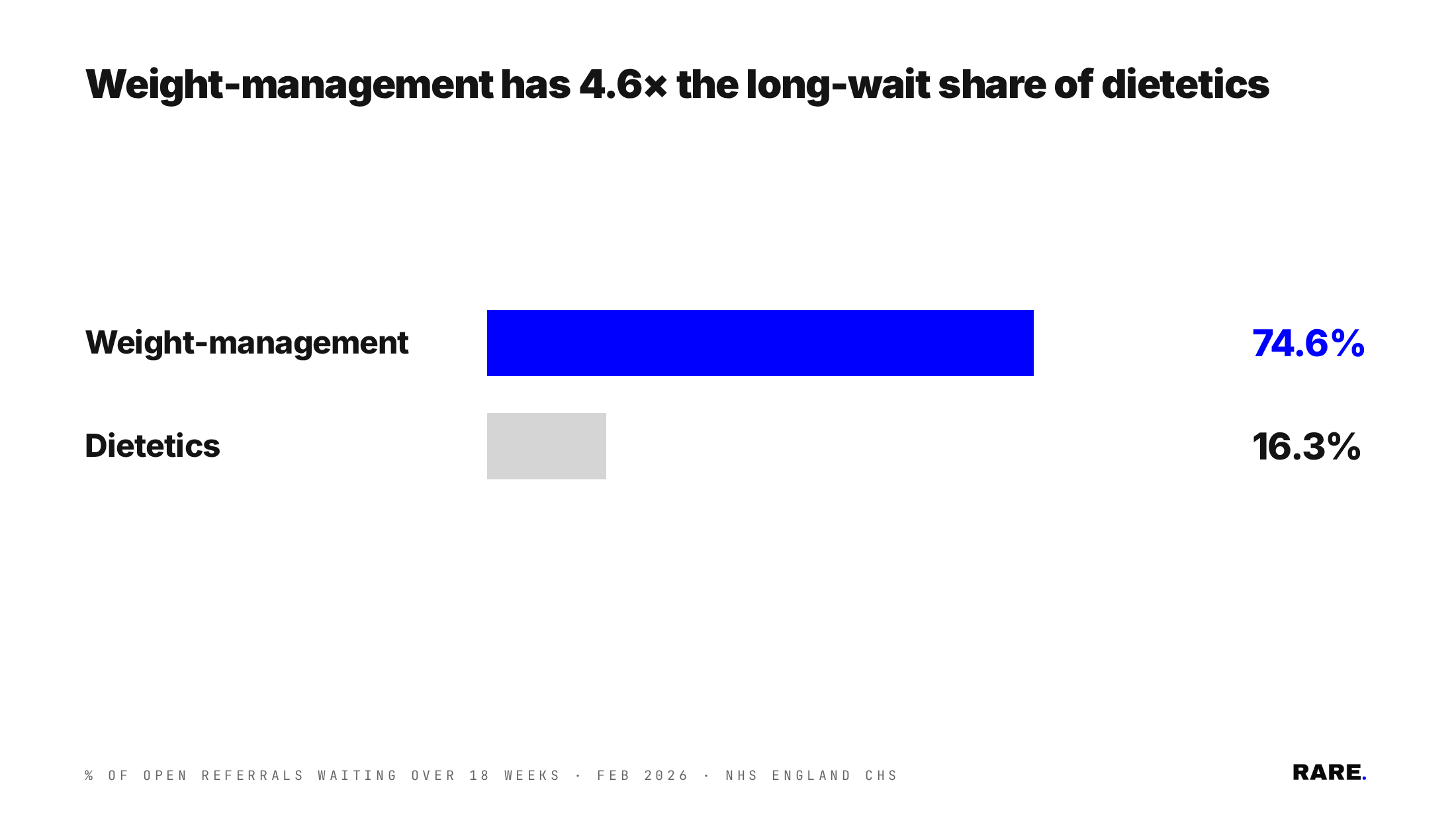
For comparison, the closest sibling service is Adult Community Dietetics. In the same month, that service recorded 34,179 open referrals, with 16.3% waiting over 18 weeks. The over-18-week share for weight-management is 4.6 times the dietetics share (on an all-region basis, 74.6% against 16.3%). The slowness is service-specific, not a community health services pattern.
Where in England does the waiting list actually sit?
The headline national figure is dominated by a single region. In February 2026, the South West region held 4,304 open referrals, 72.6% of the national total. East of England and South East reported effectively zero activity on this service across the full 38 months of data. The remaining four regions (London, Midlands, North East and Yorkshire, North West) share the balance.
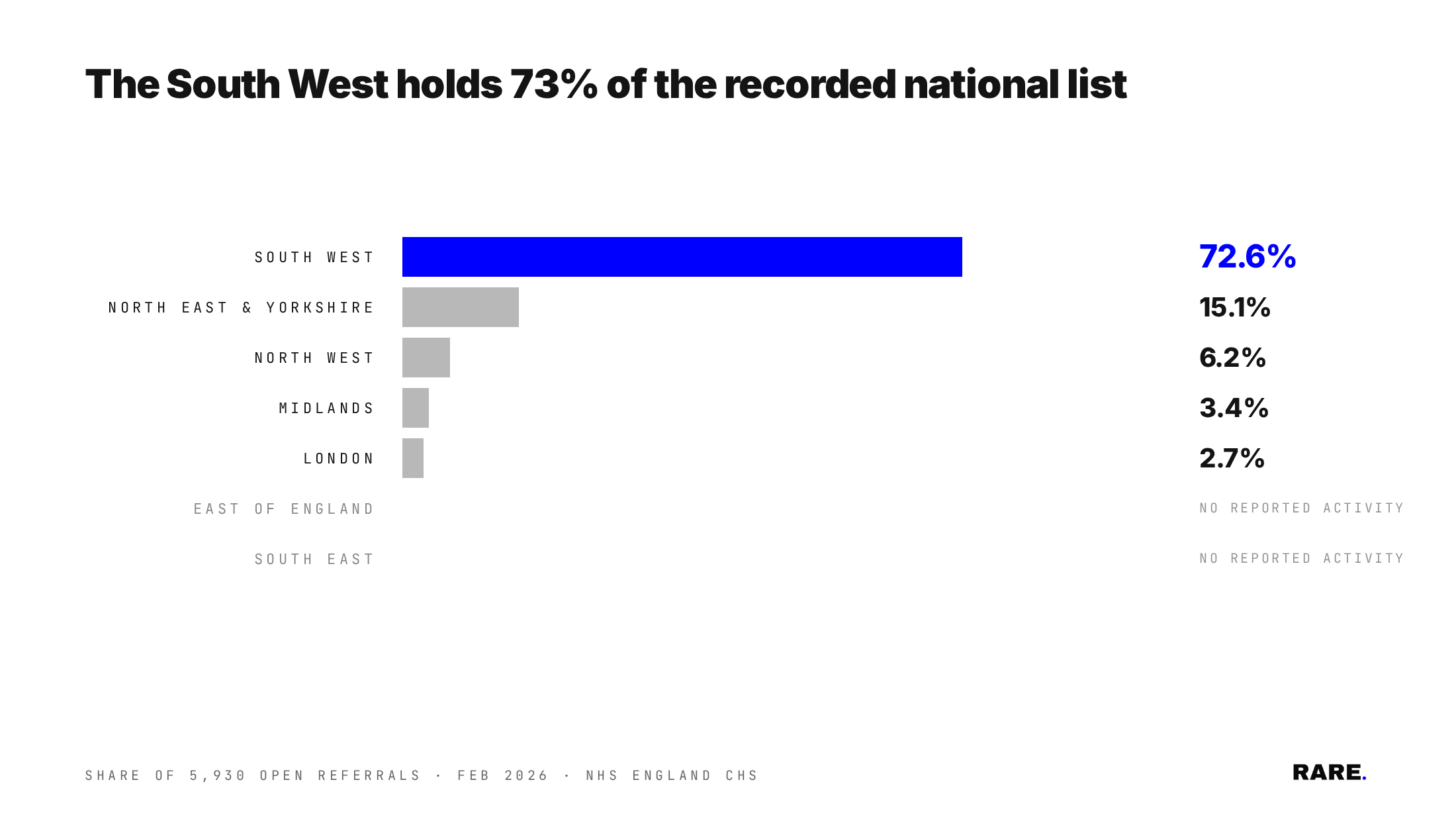
Two regions reporting near-zero is a structural absence of reportable activity, not a measure of low demand. The community pathway for weight-management and obesity is not operating consistently across England, and the national statistics rest heavily on what is happening in one region.
Why does the national trend hide a Midlands reporting break?
On first inspection, the most arresting number in the dataset is an apparent collapse in the national list, from a little over 40,000 open referrals in August 2025 to under 6,000 by February 2026. This is not a real drop.
Midlands alone moved from 31,503 referrals on the list in August 2025 to 386 in September 2025, a single-month change consistent with a reporting or classification change rather than a service-level event. The Midlands figure has stayed in the low hundreds since.
Any trend statement that uses the post-September 2025 Midlands data without isolating it would be misleading. The figures below exclude Midlands from the year-on-year trend until the NHS England statistical commentary for the September 2025 release can be checked.
How have community weight-management waits changed over three years?
With Midlands excluded, the picture across the other six reporting regions is consistent over three years.
Month | Open referrals on list | Over 18 weeks | % over 18w | Over 52 weeks | % over 52w |
|---|---|---|---|---|---|
January 2023 | 4,856 | 2,163 | 44.5% | 314 | 6.5% |
January 2024 | 7,609 | 3,924 | 51.6% | 203 | 2.7% |
January 2025 | 8,618 | 4,917 | 57.1% | 1,438 | 16.7% |
February 2026 | 5,730 | 4,400 | 76.8% | 1,916 | 33.4% |
Headcount on the list has drifted down from a 2024 peak, but the share of cases in long-wait bands has risen on every cut. The over-18-week share has gone from 44.5% to 76.8% in three years. The over-52-week share has gone from 6.5% to 33.4%.
The data is consistent with two pressures: fewer new referrals reaching the list, and referrals already on the list moving through to treatment more slowly than they once did. The community health services dataset does not separate the two cleanly; it counts open referrals and the weeks they have been open, not the rate at which they enter or leave. What the data does show is that referrals on this list in 2026 are open for longer than referrals on it in 2023.
The implication is structural, not operational
This dataset measures the recorded community weight-management waiting list, covering tier 2 and community tier 3 reported through CSDS. It does not record what a person receives when their referral reaches treatment, how many people referred to the service never appear on the list, or what happens to weight-management need in the two regions that do not run a reportable pathway.
What it does record points to a service that, at population scale, is patchy and slow. Two regions of England do not run a reportable community pathway. One region carries the majority of the recorded list. The dominant national figure (around three quarters of open referrals waiting more than 18 weeks) is concentrated, not distributed.
For commissioners and population-health analysts, that pattern is a structural finding rather than an operational one. A community service that effectively exists in one region of England is not currently a population-level access point for weight-management and obesity care. The wider questions, what residents in the two non-reporting regions are referred to instead, and how the community tier interacts with the RTT specialist and bariatric pathways, NHS and private GLP-1 access, and the Digital Weight Management Programme, sit outside this single return.
Methodology: Source data is the NHS England Community Health Services Waiting List, monthly returns from January 2023 to February 2026, filtered to the (Adult) Weight Management and Obesity Services line across seven NHS England regions and eight wait bands. The published unit is an open referral on the community service, sourced from the Community Services Data Set (CSDS); the dataset covers NHS-commissioned tier 2 and tier 3 community weight-management provision together (the two are not separated in the published statistics). One person referred more than once, or referred to more than one service, is counted more than once; no unique-patient denominator is published at service level. This is a separate return from NHS England Referral to Treatment (RTT). RTT covers elective consultant-led secondary-care pathways, including tier 3 provision delivered in a secondary-care consultant-led setting and tier 4 bariatric pathways; those sit outside this return. The return also does not include the NHS Digital Weight Management Programme, NHS specialist GLP-1 prescribing, or private prescribing. 263 of 2,219 cells in the source extract are blank, predominantly in East of England and South East. The Midlands region records a single-month change of approximately 31,000 referrals between August and September 2025 that is consistent with a reporting or classification change; trend figures in this report exclude Midlands for that reason. Headline shares in the lede and in the section 'How long are cases waiting?' use the six-region baseline that excludes Midlands; national all-seven-region figures are stated alongside where relevant. The 18-week band is a reporting benchmark for community services, not the RTT constitutional standard, which applies only to elective consultant-led secondary care. Aggregates have not been independently validated against NHS England's published statistical commentary. Per-region figures use the NHS England seven-region structure as published. Analysis by Rare.Monitor, June 2026.