The Republic of Ireland has received a favourable assessment of Wegovy, but no public funding decision has been made. The National Centre for Pharmacoeconomics (NCPE) estimates that annual reimbursement costs could range from €53 million to €880 million, depending on who qualifies. England, meanwhile, has begun a funded, phased rollout of Mounjaro (tirzepatide). Its experience shows that even after a positive funding decision, access can take years to expand.
Medicated weight-management locations are less common in Ireland
Ireland has fewer locations advertising weight management per person than the UK, according to Rare.Monitor. Its database records 1,275 Irish locations, equivalent to 24.76 per 100,000 people, compared with 38.76 per 100,000 in the UK.
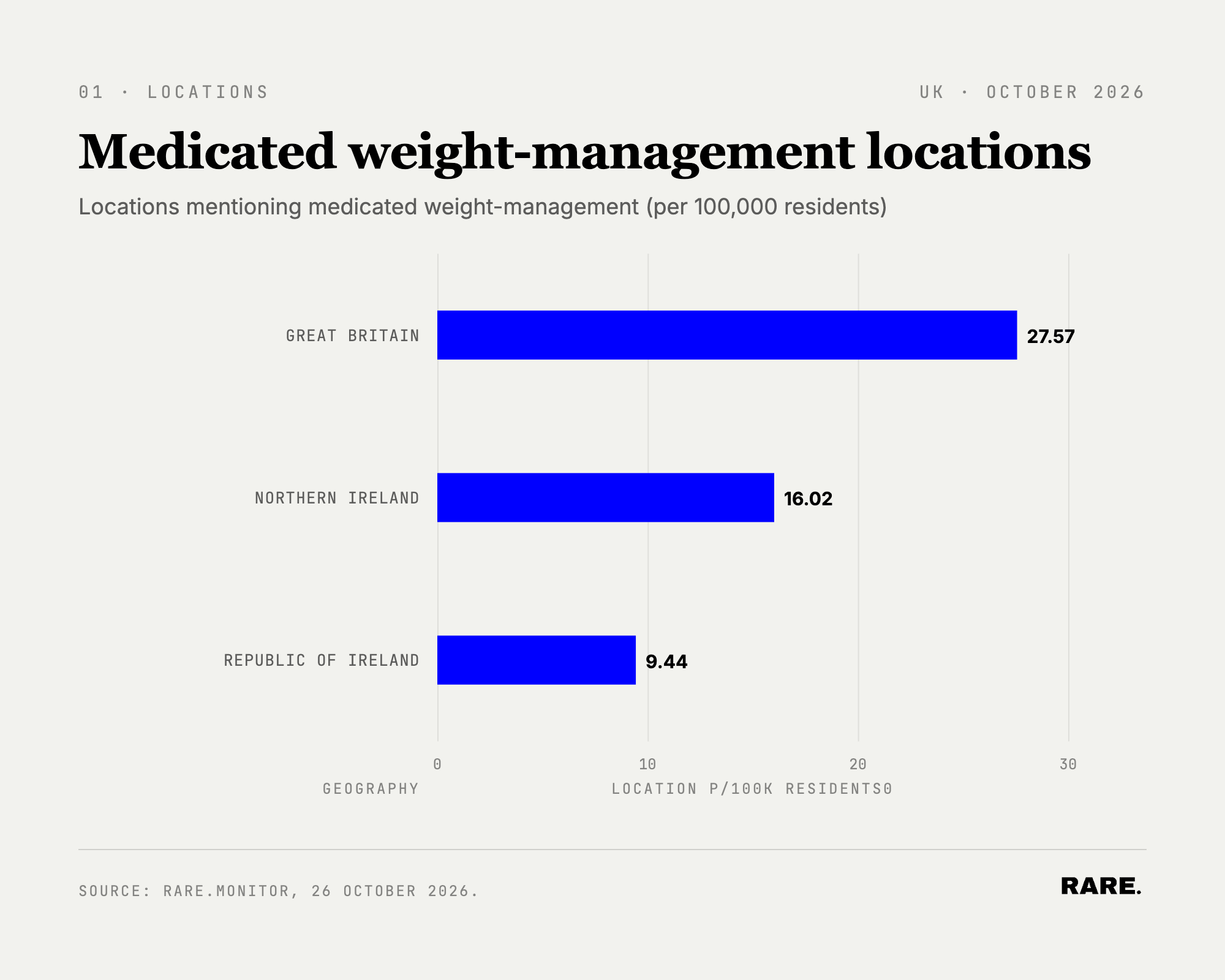
The figures provide context on the services advertising weight management, but they do not measure prescriptions, drug sales or the number of patients receiving treatment. They also cannot establish how many listed locations prescribe weight-loss medication.
Source: Rare.Monitor, 26 October 2026. Location counts reflect verified listings advertising medicated weight management or a weight-management programme.
Eligibility could change Ireland’s annual bill by €827 million
The NCPE has recommended that the Health Service Executive (HSE) consider reimbursing Wegovy. But the potential cost varies dramatically with eligibility. The published five-year estimates of €265 million and €4.4 billion translate to annual equivalents of approximately €53 million and €880 million respectively.
The narrower scenario covers adults with severe obesity and a related condition. The wider assessment also includes adults with obesity and some people with a lower body mass index alongside a related condition. The difference illustrates how the eligibility rules would shape both public expenditure and the number of people able to access treatment.
Neither figure is an approved budget or a forecast of actual uptake. They are modelled reimbursement scenarios, and the HSE has yet to announce a funding decision or an access timetable.
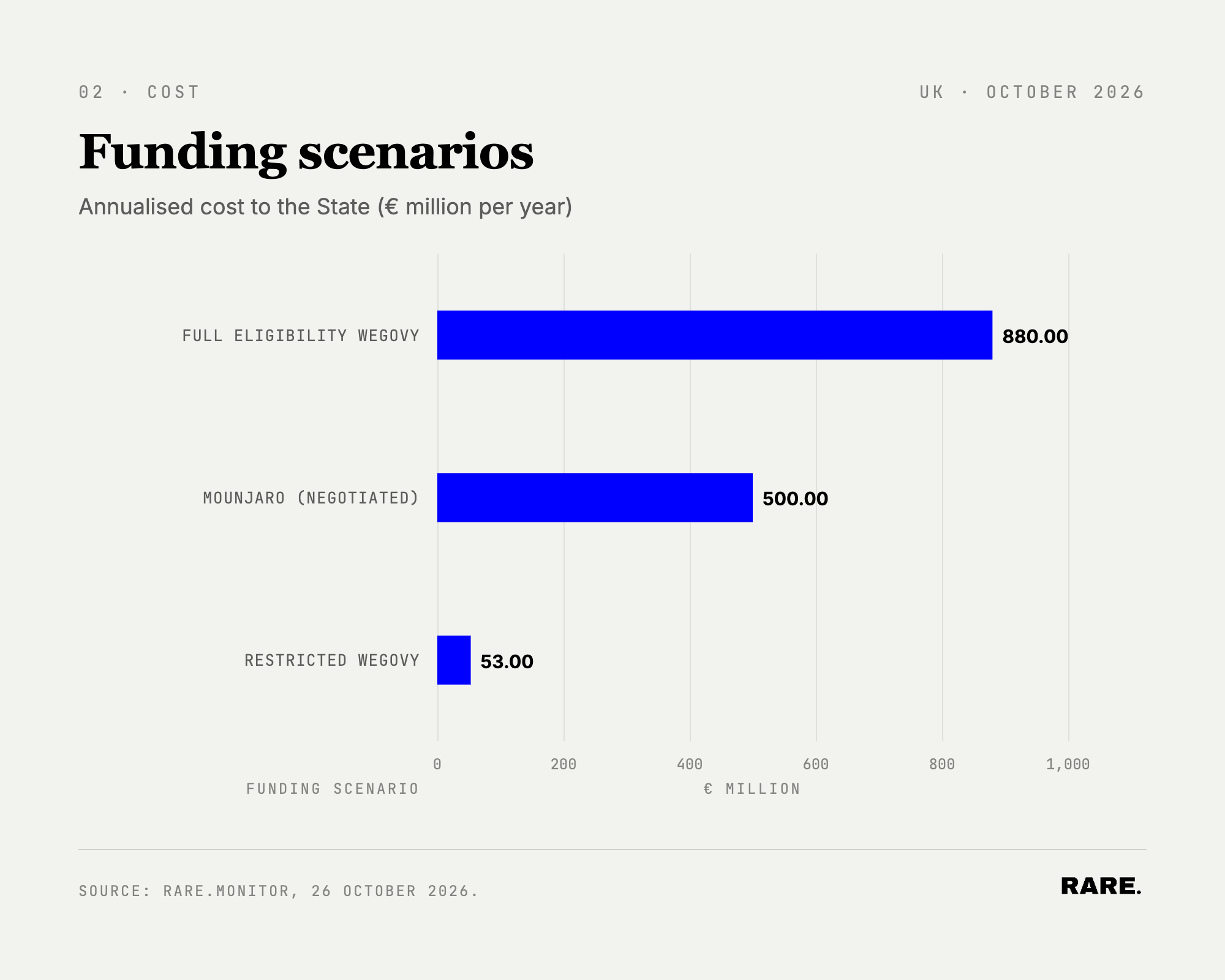
Suggested caption: Modelled annual HSE costs for Wegovy under narrower and wider eligibility scenarios. Figures are annualised from published five-year estimates and are not approved budgets. Source: NCPE and The Journal; Rare analysis, 2026.
Mounjaro remains a separate decision. The NCPE found tirzepatide was not cost-effective at the submitted price, although a price reduction could change that assessment. Irish Times reporting on 15 October 2026 cited possible annual public costs of €400 million to €600 million following a negotiated reduction. That range reflects public remarks, not a published drug-cost table, and should not be treated as an approved funding scenario.
England shows that funding does not mean immediate access
England began a phased primary-care rollout of tirzepatide on 23 June 2025. The planned reach for the first three years is around 220,000 people, compared with approximately 3.4 million who meet the full eligibility criteria. The initial figure is a target, not a count of patients already treated, and wider access could take up to 12 years.
Population | People (thousands) |
|---|---|
First 3 years: planned | 220 |
Full eligible population | 3,400 |
England’s planned first three years of rollout compared with the full eligible population. The figures describe planned reach and eligibility, not observed treatment numbers. Source: NHS England and NICE, 2026.
The comparison matters for Ireland because a positive assessment is only one step towards treatment. Funding terms, eligibility rules and the pace of implementation all affect how many patients receive medication and when. England’s experience offers a reference point, but it does not establish what Ireland’s eventual arrangements would look like.
Reported NHS community prescribing expenditure on tirzepatide reached £574 million in 2025/26, according to MIMS reporting. This is actual reported spending, but it covers prescriptions across indications, including diabetes, rather than weight management alone. It therefore cannot be directly compared with Ireland’s modelled Wegovy costs as if both figures measured the same market.
Ireland still lacks a clear picture of current use
There is also a gap in the data on weight-loss medication use. A UCL survey published in January 2026 estimated that 1.6 million adults in Great Britain had used a weight-loss drug in the preceding 12 months. An IQVIA estimate put the number of people receiving ongoing medication across the UK at about 1.5 million in March 2025. Although the measures cover different periods and populations, both suggest uptake of roughly 3% of adults.
If Ireland matched that rate, around 125,000 adults would use weight-loss medication. Applying published private prices of €215 to €475 a month over a full year produces a hypothetical annual consumption value of approximately €300 million to €740 million. This is not an estimate of current Irish spending: no published Irish user count is available, and the calculation assumes a full year of treatment for every user.
Measure | Adult uptake (%) | Adult users (people) |
|---|---|---|
UK uptake estimate from a Great Britain survey | ≈3% | |
Great Britain adults reporting use in the prior 12 months | 1.6 million | |
UK uptake sensitivity | 2.9% to 3.0% | |
Ireland if uptake matched the UK, hypothetical | ≈125,000 | |
Irish hypothetical sensitivity | 123,000 to 129,000 | |
Current Irish users | No published count | |
IQVIA modelled UK estimate, March 2025 | 1.5 million |
Rare.Monitor records 1,275 Irish locations advertising weight management, equivalent to 24.76 per 100,000 people, compared with 38.76 per 100,000 in the UK. These listings provide context on advertised services, not a count of prescribers, prescriptions or patients treated.
The funding decision will determine the next steps
As of 26 October 2026, the HSE had given no date for a Wegovy or Mounjaro funding decision for weight loss. Ireland’s modelled costs show how heavily public expenditure depends on eligibility, while England’s rollout demonstrates that funded access can still take years to reach the full eligible population.
Until the HSE sets out its funding decision, eligibility rules and implementation timetable, neither the eventual public cost nor the pace of patient access can be established.
Key findings
UK estimates suggest around 1.5 million to 1.6 million people use weight-loss medication, equivalent to roughly 3% of adults. Ireland has no published equivalent user count.
If Ireland matched UK uptake, around 125,000 adults would use weight-loss medication. At published private prices, that would represent a hypothetical €300 million to €740 million in annual consumption — not an estimate of current Irish spending.
Wegovy’s modelled annual HSE reimbursement cost ranges from approximately €53 million to €880 million, depending on eligibility criteria. These are scenarios, not an approved budget, and relate to a separate public funding decision.
NHS England’s planned three-year primary-care rollout of Mounjaro (tirzepatide) targets around 220,000 people, compared with approximately 3.4 million eligible adults. The target is not an observed treatment count, and wider access is expected to take years.
What this means
Ireland has no published count of people using weight-loss medication and no HSE funding decision for Wegovy or Mounjaro for weight loss. UK uptake provides a useful benchmark for illustrating potential demand, but it cannot establish the size or value of Ireland’s current private market. The HSE’s eventual decision on funding, eligibility criteria and implementation will shape how many people can access treatment through the public system and how quickly that access expands.
Methodology
Location data: Rare.Monitor, 26 October 2026. Five-year Wegovy cost totals: NCPE Wegovy assessment and The Journal, October 2026. Annual equivalents and other calculations: Rare analysis. UK use is estimated from a Great Britain survey and corroborated by a separate UK monthly model; the Irish uptake and private consumption value are hypothetical, not current spending or HSE budget figures. The location density rates use Ireland's 2022 census population and the UK's 2022 population estimates so they compare like for like. The uptake figures use current population estimates. England's 220,000 people is a three-year target, not achieved uptake. Location counts show mentioned services, not prescribing or patients.