
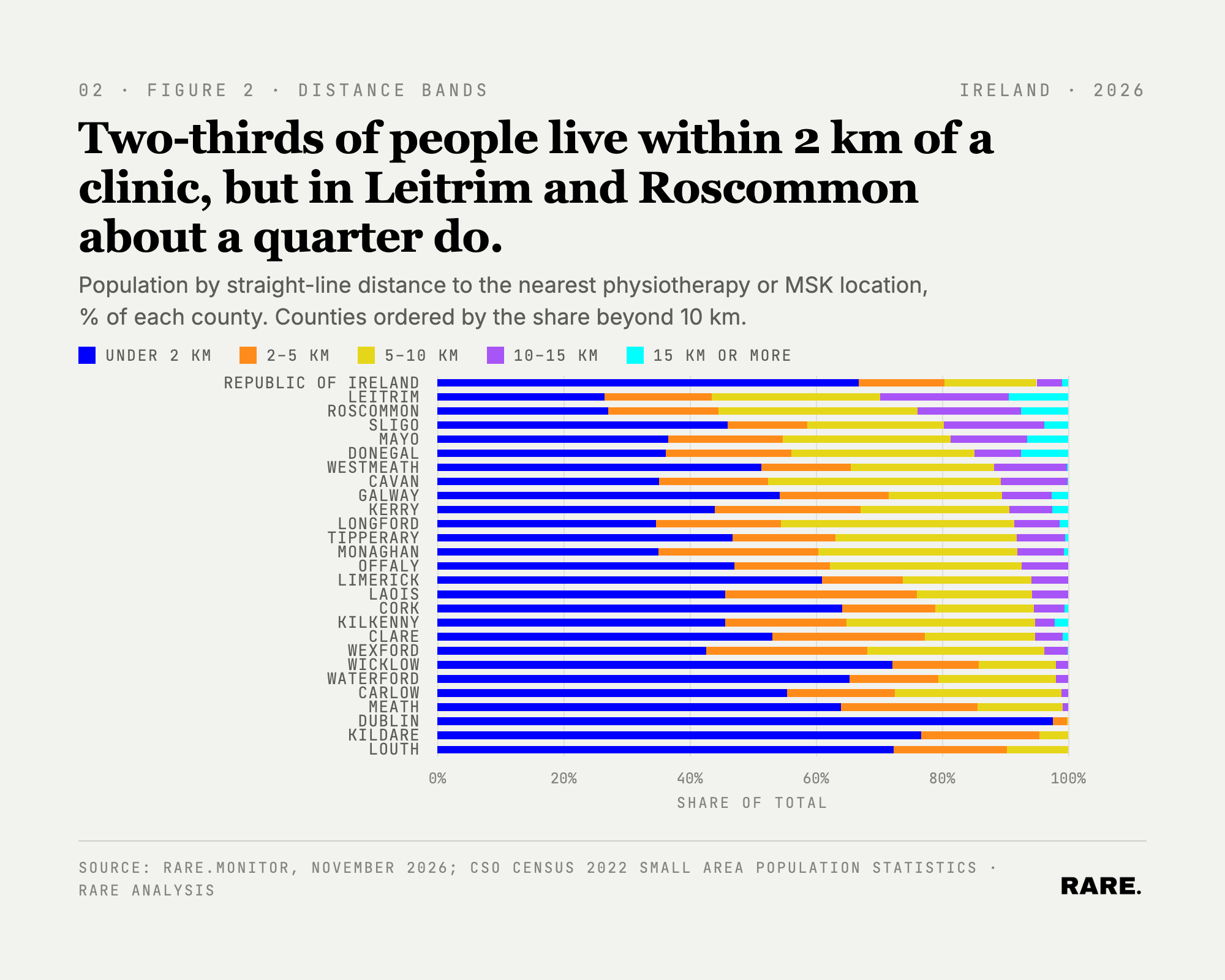
One in twenty people in the Republic of Ireland lives more than 10 km from the nearest physiotherapy or MSK clinic they can book directly. That is 259,635 people. For two-thirds of the population the nearest clinic is within 2 km, and in Dublin the figure is 97.6%.
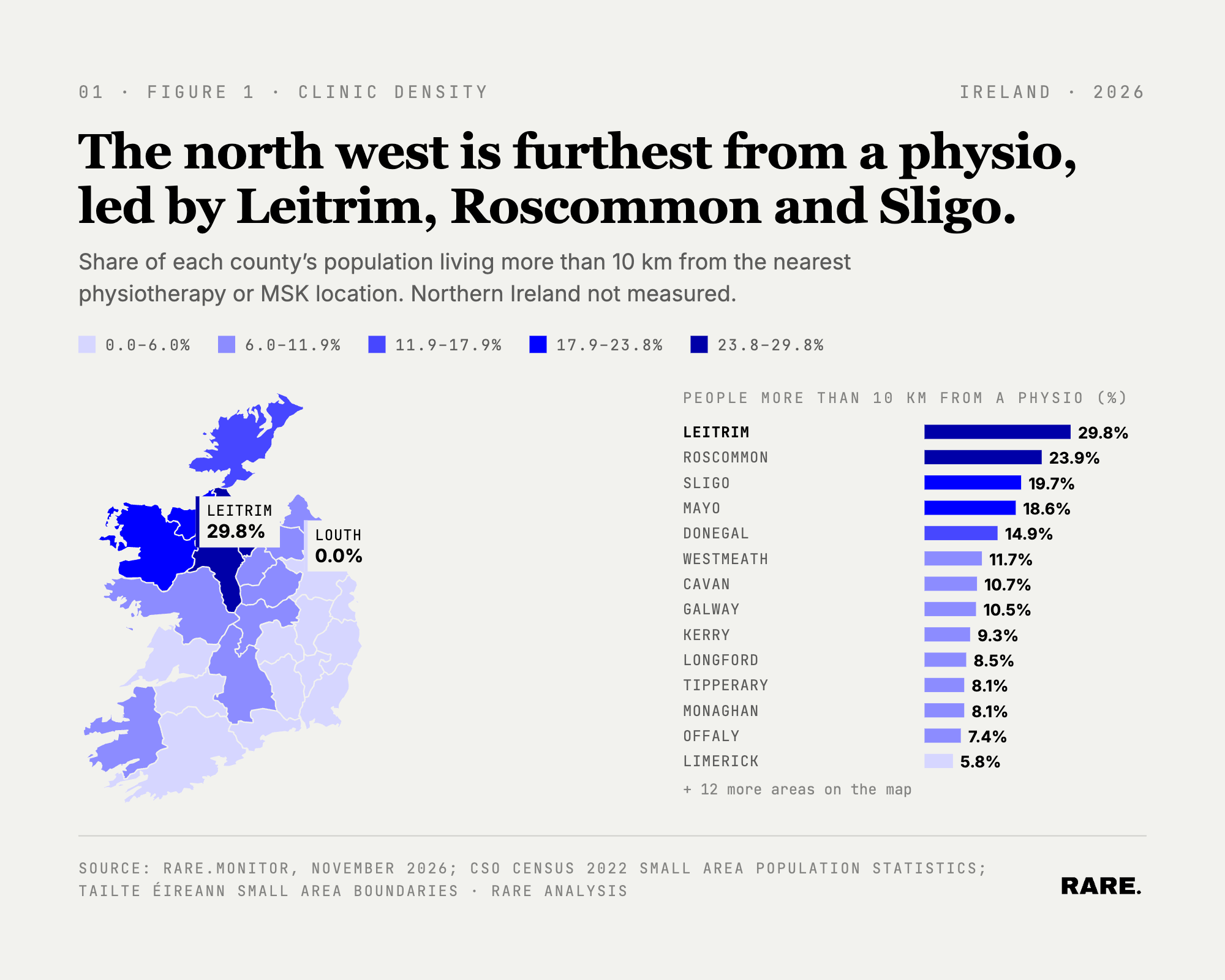
Leitrim sits at the other end. Of its residents, 29.8% live more than 10 km from a clinic, and the population-weighted median distance is 7.0 km, against 0.8 km nationally. Roscommon follows at 23.9%, then Sligo (19.7%), Mayo (18.6%) and Donegal (14.9%).
The north west carries a third of the gap
Those five counties are home to 9% of the country's population but 35% of the people more than 10 km from a clinic. The longest distances are there too. In Donegal 4.2% of residents are more than 20 km from a clinic, and in Mayo 3.1%. The most remote Small Area, in Donegal, is 31.5 km away.
These are largely rural counties, and farming is hard on the body. In a survey of 600 Irish farmers, 56% had had a musculoskeletal injury, most often to the back. Where the nearest clinic is more than 10 km away, getting treatment for that kind of injury means a longer trip.
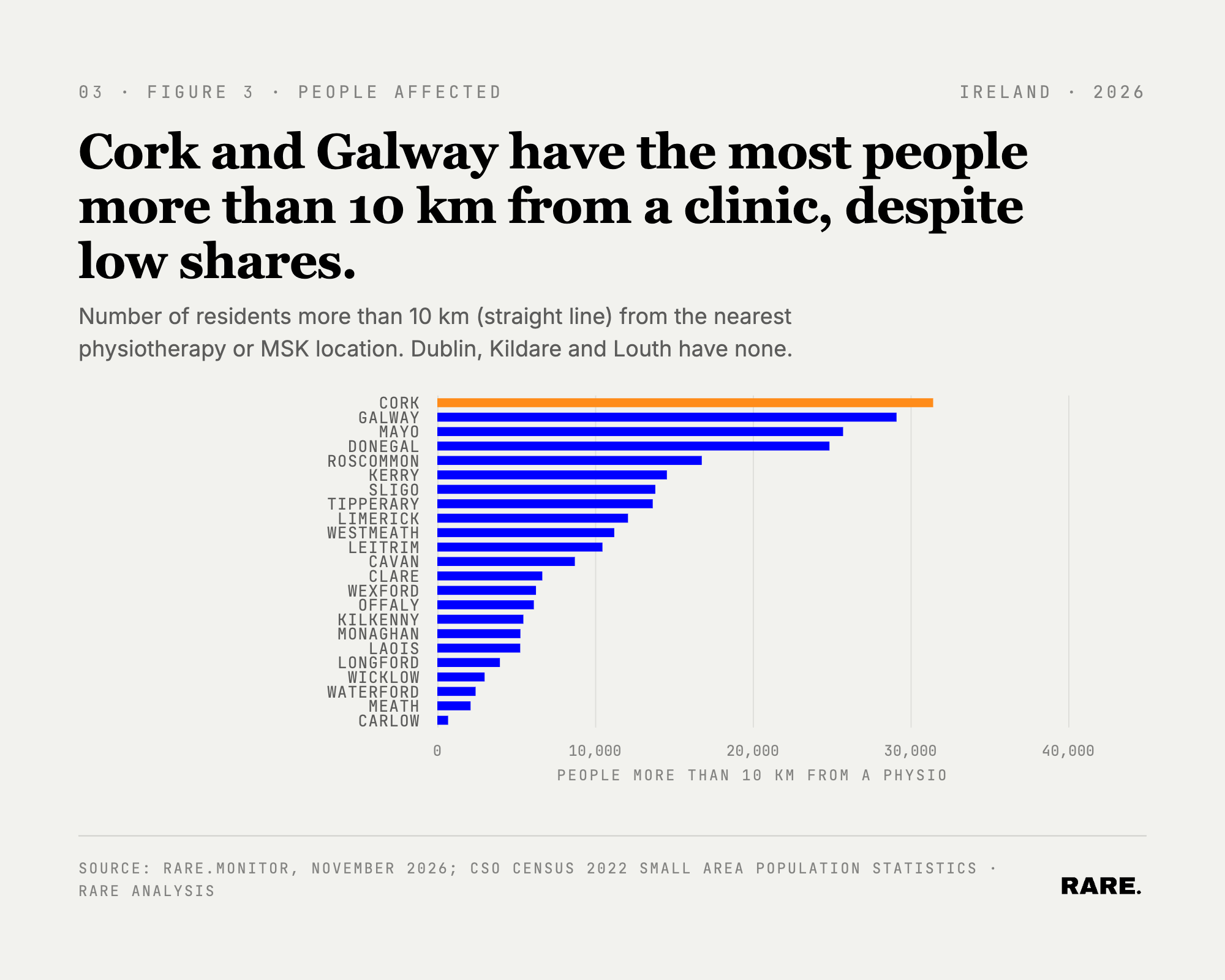
The gap is not only a western one. Cork has the largest number of people beyond 10 km, 31,437, because a small share of a large county is still a lot of people. Galway follows with 29,117.
Counting clinics is not the same as reaching them
Provider rates per head hide this. Sligo has the highest rate in the country, 48.4 locations per 100,000 people, yet one in five of its residents is more than 10 km from any of them. A high count does little for people who live far from where the clinics are.
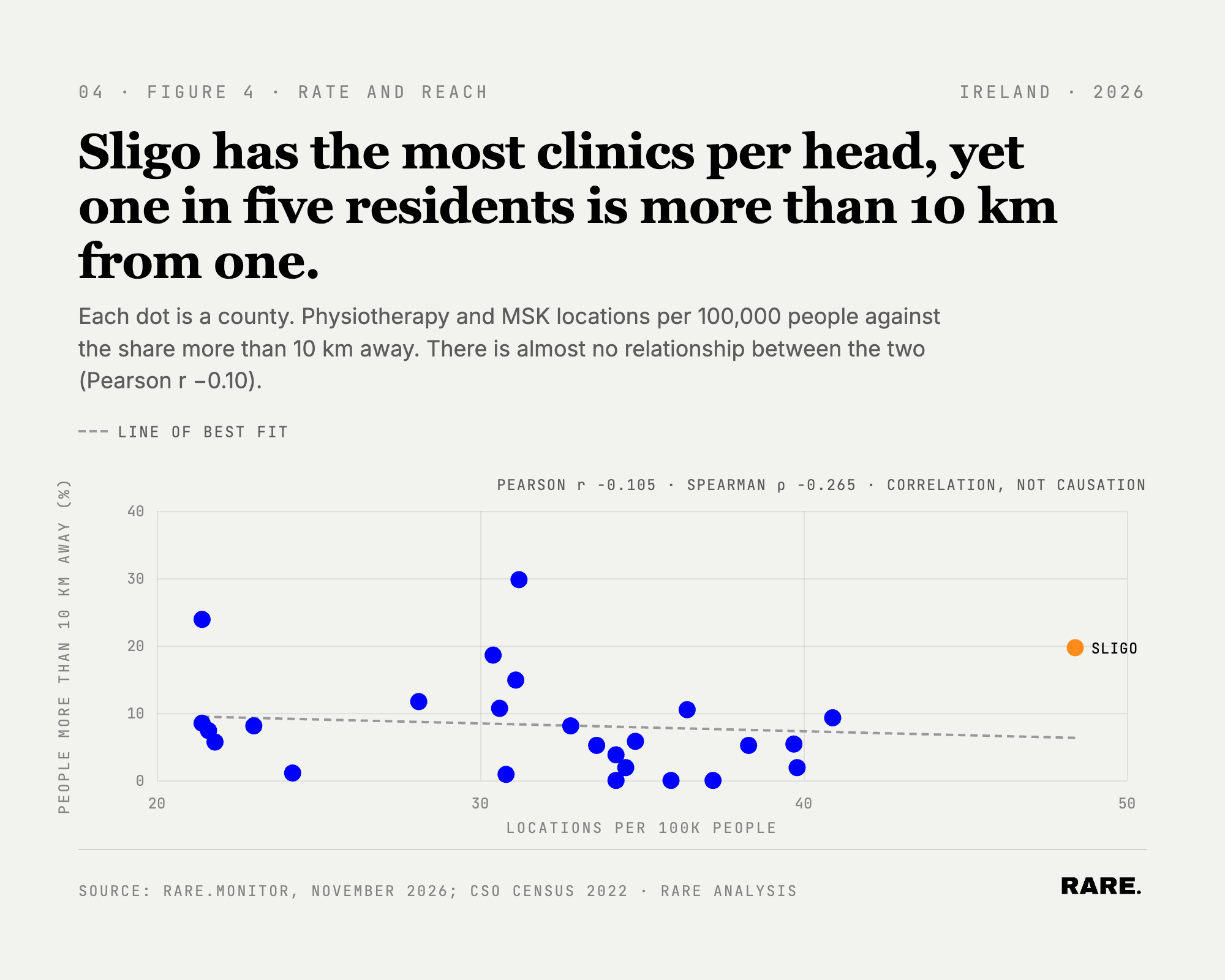
Longford shows the reverse. Its rate is among the lowest, 21.4 per 100,000, but only 8.5% of residents are more than 10 km away, because it is a compact county. Roscommon has the same rate and the second-largest share beyond 10 km, so it is short on both counts.
The border helps Donegal and Monaghan
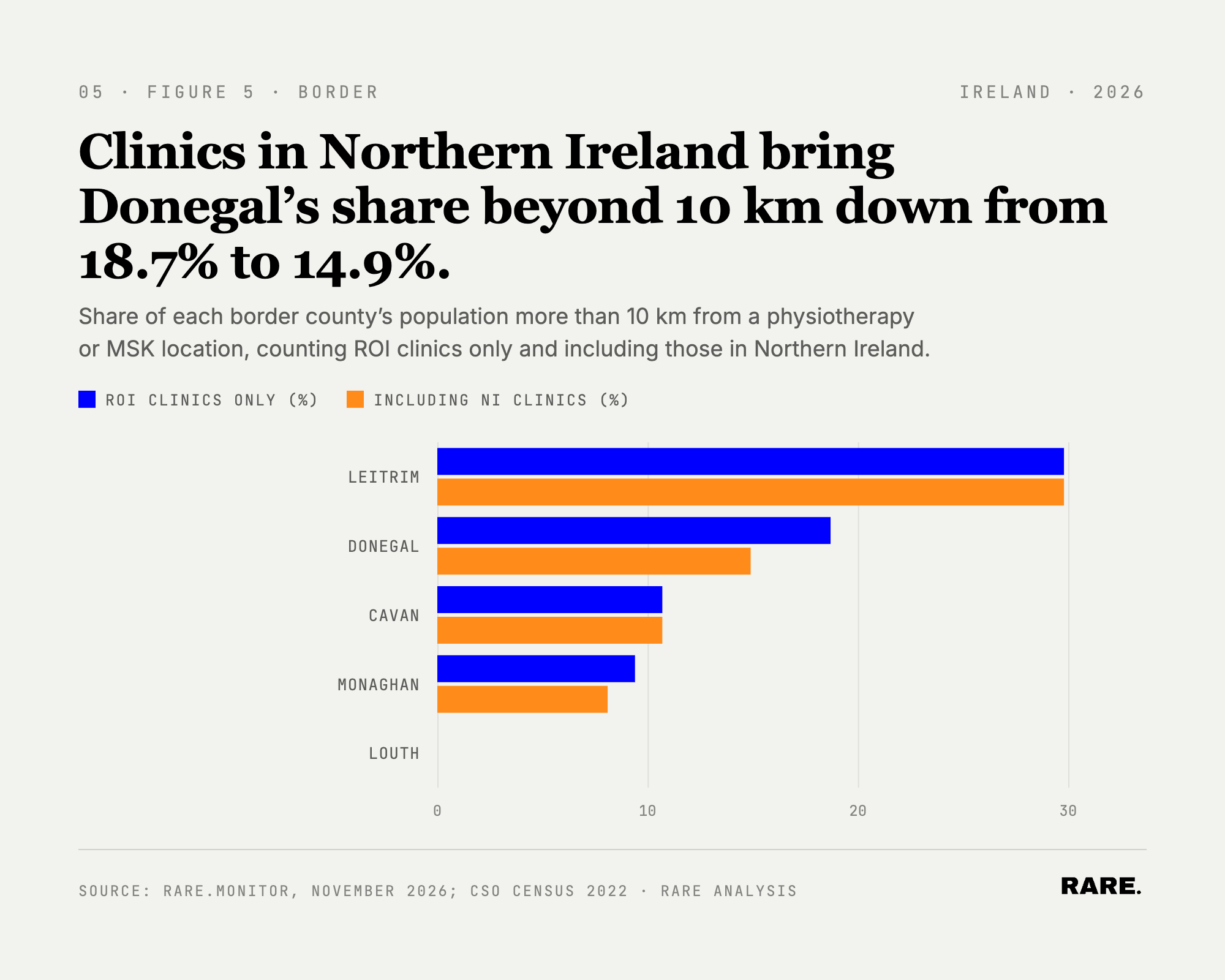
For some residents of border counties, the nearest clinic is in Northern Ireland. Without those clinics, Donegal's share beyond 10 km would rise from 14.9% to 18.7%, and Monaghan's from 8.1% to 9.4%. Elsewhere the border makes no difference at this distance.
Part of a wider pattern
Leitrim and Donegal also appear in the CSO's 2026 Measuring Distance to Services among the least accessible counties for HSE healthcare more broadly. Half of all households in Leitrim are more than 38 km from their nearest HSE General Hospital. The pattern is not specific to physiotherapy.
The clinics counted here are the ones people can book directly, mostly private, at €60–80 for 30 minutes. HSE physiotherapy in primary care centres and hospitals is not counted, so someone close to a public service can still be a long way from a clinic they can walk into. Public physiotherapy needs a referral, and it is under strain. A survey of HSE physiotherapy managers cited by the Irish Society of Chartered Physiotherapists put vacancy rates at around 40% in 2025. In February 2024 the Dáil heard that the physiotherapy service at Manorhamilton hospital in north Leitrim had gone from five days a week to two. The ESRI has found that healthcare supply in the ROI has not been allocated according to population need since at least 2014.
Where public services are thin, the north west is also where the nearest private clinic is furthest away.
The same geography shapes dental access: web presence among dental providers varies sharply by province. For England, where physiotherapy supply is read against NHS orthopaedic waiting times, see where England's physiotherapy supply is thinnest.