
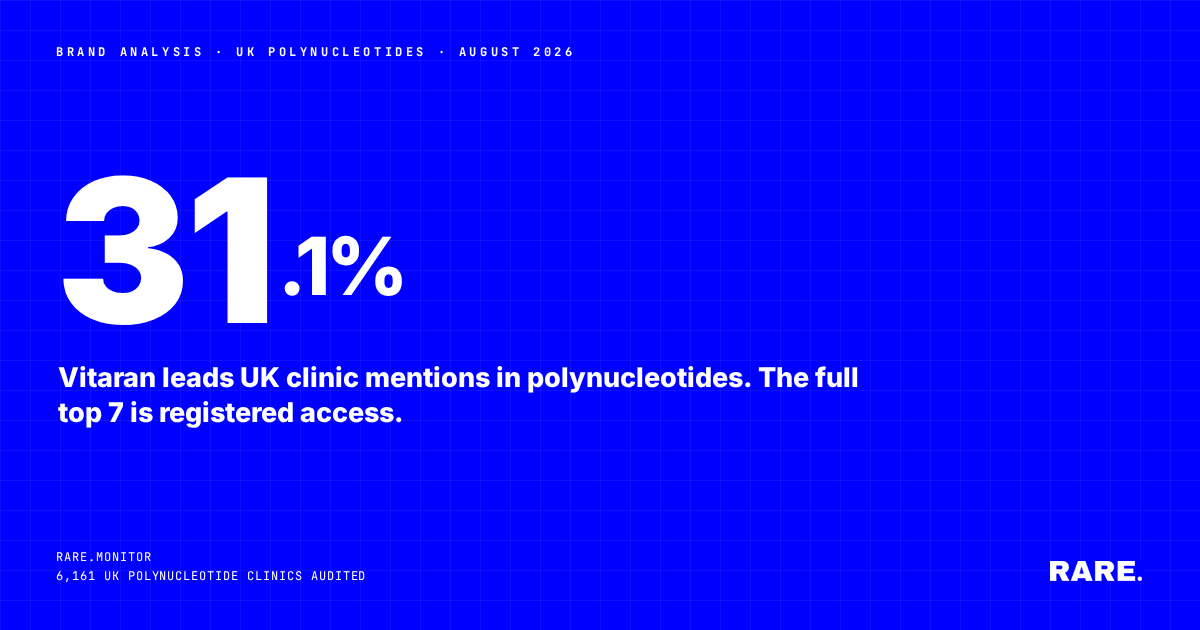
Brand analysis: UK polynucleotides, August 2026
August 2026 / Medical Aesthetics / UK
More analyses
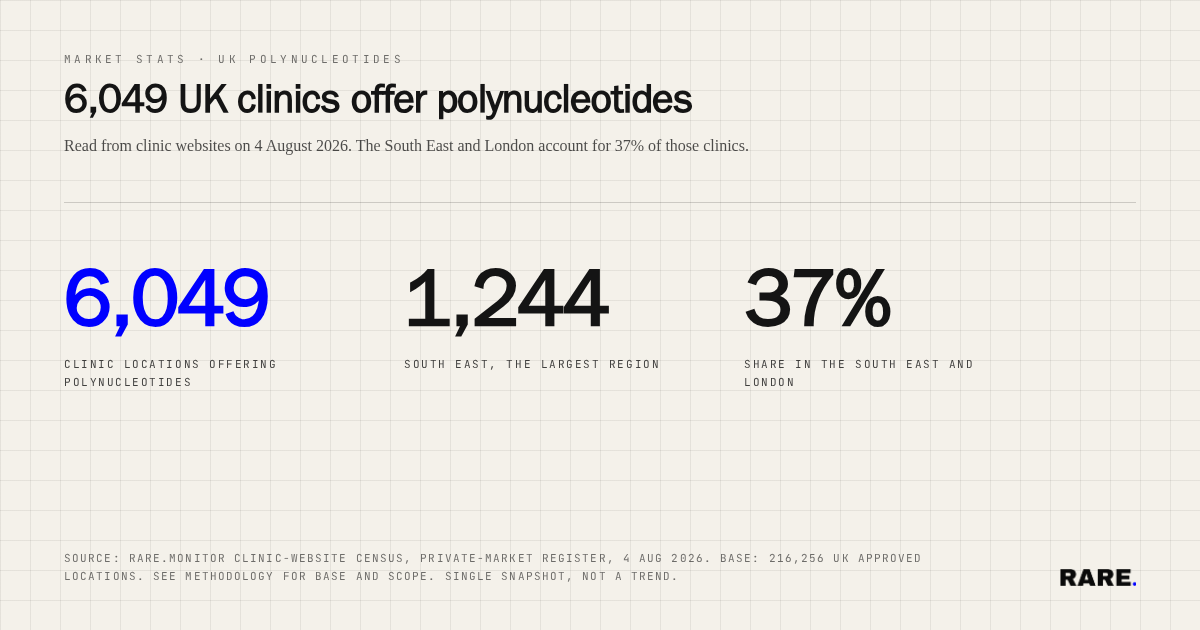
6,049 UK Clinics Offer Polynucleotides
August 2026 / Medical Aesthetics / UK
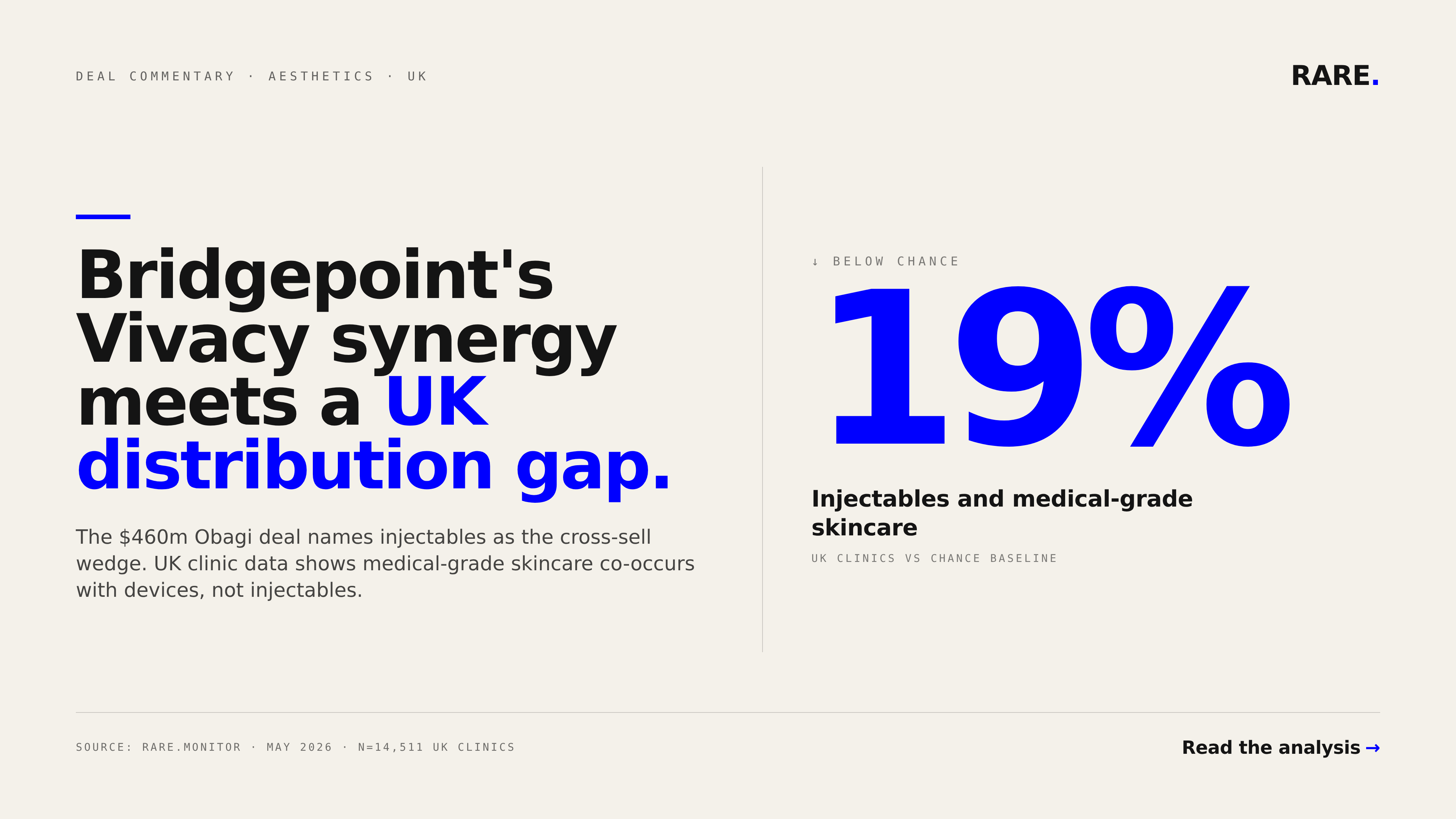
Bridgepoint buys Obagi: is the injectables-led UK strategy the right one?
June 2026 / Medical Aesthetics / UK
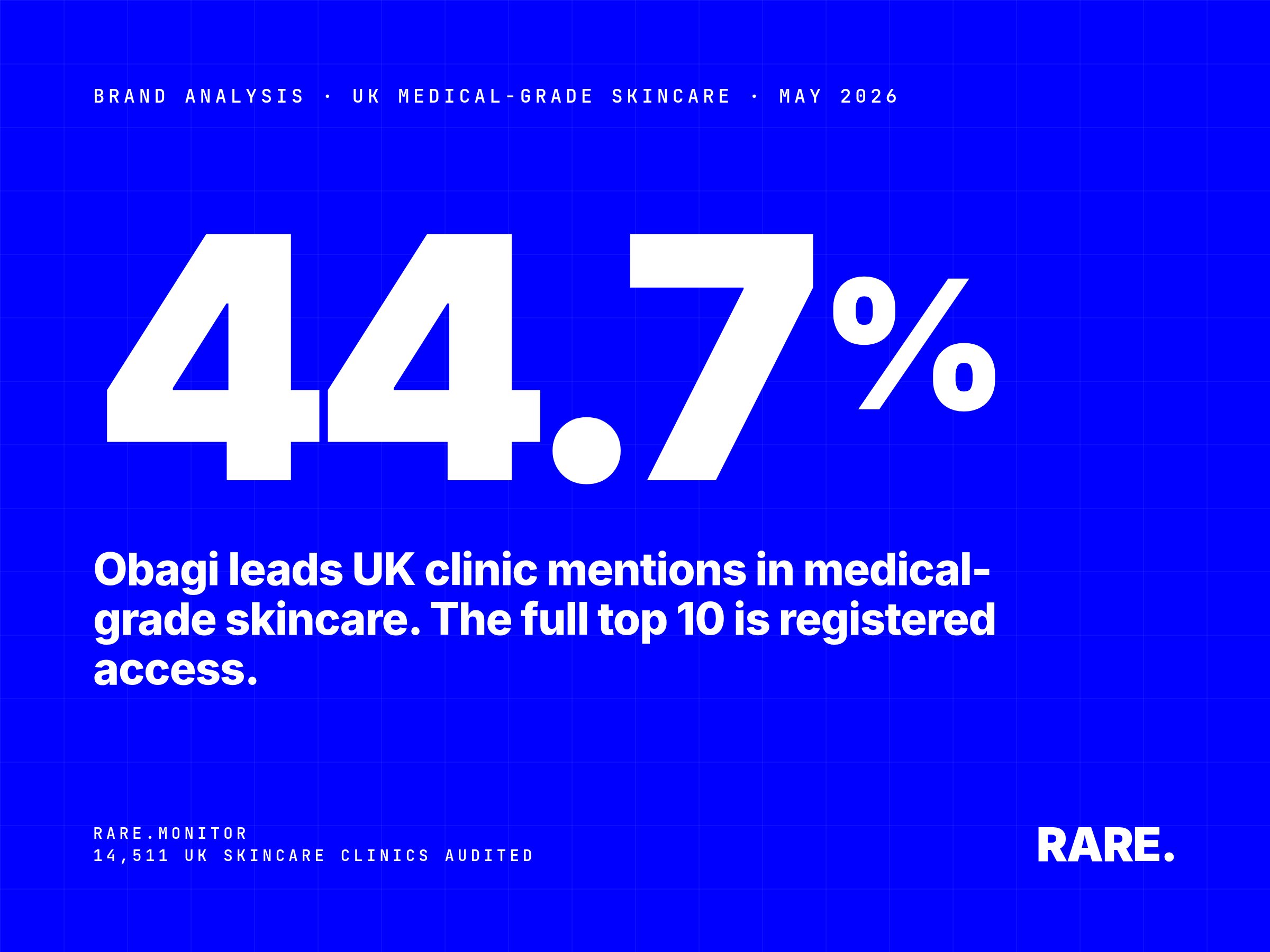
Brand analysis: UK Medical-Grade Skincare, May 2026
May 2026 / Medical Aesthetics / UK
About this market
Rare.Monitor classifies 36,840 UK locations and 1,503 in the Republic of Ireland as non-surgical medical aesthetics, across 28 catalogued treatment categories. The classification covers practitioner-administered injectables, energy-based devices and skin-conditioning treatments, not the general beauty services outside the practitioner standards set by the Joint Council for Cosmetic Practitioners. Figures are restated on each new read of each location's published text.
Botulinum toxin and dermal fillers each reach more than half of UK locations
Botulinum toxin is recorded at 20,218 UK locations and dermal fillers at 19,699, each more than half of the 36,840 total. Skin boosters follow on 12,680 and thread lifts on 9,391. Body contouring reaches 8,633 locations, laser hair removal 8,221 and polynucleotides 5,634. Categories overlap and are not additive: the average UK location records 4.72 of the 28 categories, and 41.2% record five or more.
Polynucleotide records are geographically concentrated. The South East accounts for 1,244 clinics offering the treatment and London for 1,036, together 37% of the 6,049 UK clinics recording the category. Both regions sit at the top of the category before any other region is reached.
Prescription skincare and chemical peels are classified under dermatology rather than in these 28 categories, so one clinic can sit in both markets. Inside the medical aesthetics classification, biostimulators reach 4,959 UK locations and exosomes 2,071. Regenerative treatments are already recorded at scale alongside the injectable and device lists.
The Republic of Ireland follows its own category order
Rare.Monitor records 1,503 locations in the Republic of Ireland under the same classification, and they order differently from the UK. Laser hair removal appears at 343 and body contouring at 339, effectively level on 22.8% and 22.6% of that base. Chemical peels reach 271 locations, microneedling 243 and exosomes 144.
Any brand or distribution plan that treats the two markets as interchangeable will miss that device, peel and microneedling breadth. Irish locations also concentrate in the east: Leinster holds 62.5% of them and Dublin 396, so a first territory starts there.
What the data is used for
Commercial teams use Rare.Monitor in this market to map brand distribution at location level, identify whitespace in treatment category coverage and see where emerging treatments such as polynucleotides and exosomes are already recorded.
Geographic splits at postcode and Eircode level support territory planning and field-team targeting across medical aesthetics, dermatology and adjacent sectors.
FAQ
Frequently asked questions
Questions answered from Rare.Monitor data, figures read 21 August 2026.
How large are the UK and Irish medical aesthetics markets?
Rare.Monitor classifies 36,840 UK locations and 1,503 Republic of Ireland locations as non-surgical aesthetics. The classification covers injectable, device-led, regenerative and adjacent treatment categories. Categories overlap because most clinics publish more than one treatment. Source: Rare.Monitor, figures read 21 August 2026.Which treatments have the widest UK clinic presence?
Botulinum toxin is recorded at 20,218 UK medical aesthetics locations and dermal fillers at 19,699, each more than half of the 36,840-location market classification. Skin boosters reach 12,680, thread lifts 9,391, body contouring 8,633 and laser hair removal 8,221. Counts are restricted to the same classification and are not additive. Source: Rare.Monitor, figures read 21 August 2026.Which treatment categories have the widest recorded presence in Ireland?
Within the 1,503 Republic of Ireland locations classified as non-surgical aesthetics, laser hair removal appears at 343 and body contouring at 339. The four-location difference is too small to support a strong ranking. Chemical peels reach 271 locations, microneedling 243 and exosomes 144. These are published-treatment records, not treatment volumes or demand. Source: Rare.Monitor, figures read 21 August 2026.Why does treatment data matter to manufacturers and distributors?
Treatment data shows how many locations publish a category and where those locations are recorded. It helps a supplier define a relevant prospect list without treating every medical aesthetics business as equally suitable. It does not measure procedures, product sales or patient demand.What can Rare.Monitor show about medical aesthetics distribution?
Rare.Monitor connects location-level treatment records with brand disclosures, geography and available ownership data. Teams can compare clinic groups and regional patterns across the UK and Ireland. Ownership matching is not complete, particularly in Ireland, so any ownership analysis must state the records used.
Methodology: Rare.Monitor is a private-market dataset built from what locations publish about their services. Treatment counts record published treatment categories, not procedures performed, installed devices, patient demand or revenue. Categories overlap and are not additive. The UK and Republic of Ireland totals and the UK category counts were read on 21 August 2026 on the approved non-surgical aesthetics classification, which also carries 837 approved UK locations classified as surgical aesthetics. The polynucleotide regional split uses a separate 4 August 2026 read of 6,049 UK clinics, and the Leinster and Dublin figures an earlier 1,458-location Irish read, so neither is counted on the 21 August base and neither is divided into it. Every count is a single read rather than a matched pair, so no figure on this page measures change over time, and the four-location gap between laser hair removal and body contouring in Ireland is too small to rank one above the other. Irish injectable counts have not been re-derived on that base, so no UK against Ireland category order is stated. Most records have not yet had a full treatment re-scrape, so a count covers the locations detected so far rather than every location offering the treatment. Ownership matching is incomplete, particularly in Ireland, so no national Ireland ownership conclusion is drawn. Source: Rare.Monitor.