
As the NHS continues to struggle with overwhelming waitlists and under-funding, people are beginning to look to private healthcare providers for all aspects of their health, including private vaccinations. Although some of our vaccines are available on the NHS, the need for private vaccines is growing within the UK for various reasons, from requiring vaccines for travel to personal health reasons.
Quality of care, vaccine efficacy and price all influence UK consumer decisions to pay privately for vaccination, with each factor cited by half or more of UK adults surveyed, according to Rare. research. As NHS pressure pushes more UK consumers towards private vaccination, the commercial battleground is no longer whether to go private but how providers communicate quality, efficacy and cost to a consumer base that has historically defaulted to free NHS care.
What drives UK consumers to pay privately for vaccination?
UK consumers approach private vaccination with cost-sensitivity sitting alongside quality and efficacy expectations. 50% of UK adults surveyed cite pricing as an influential factor in deciding whether to pay privately for a vaccine. 56% cite the efficacy of vaccines, and 57% cite quality of care.
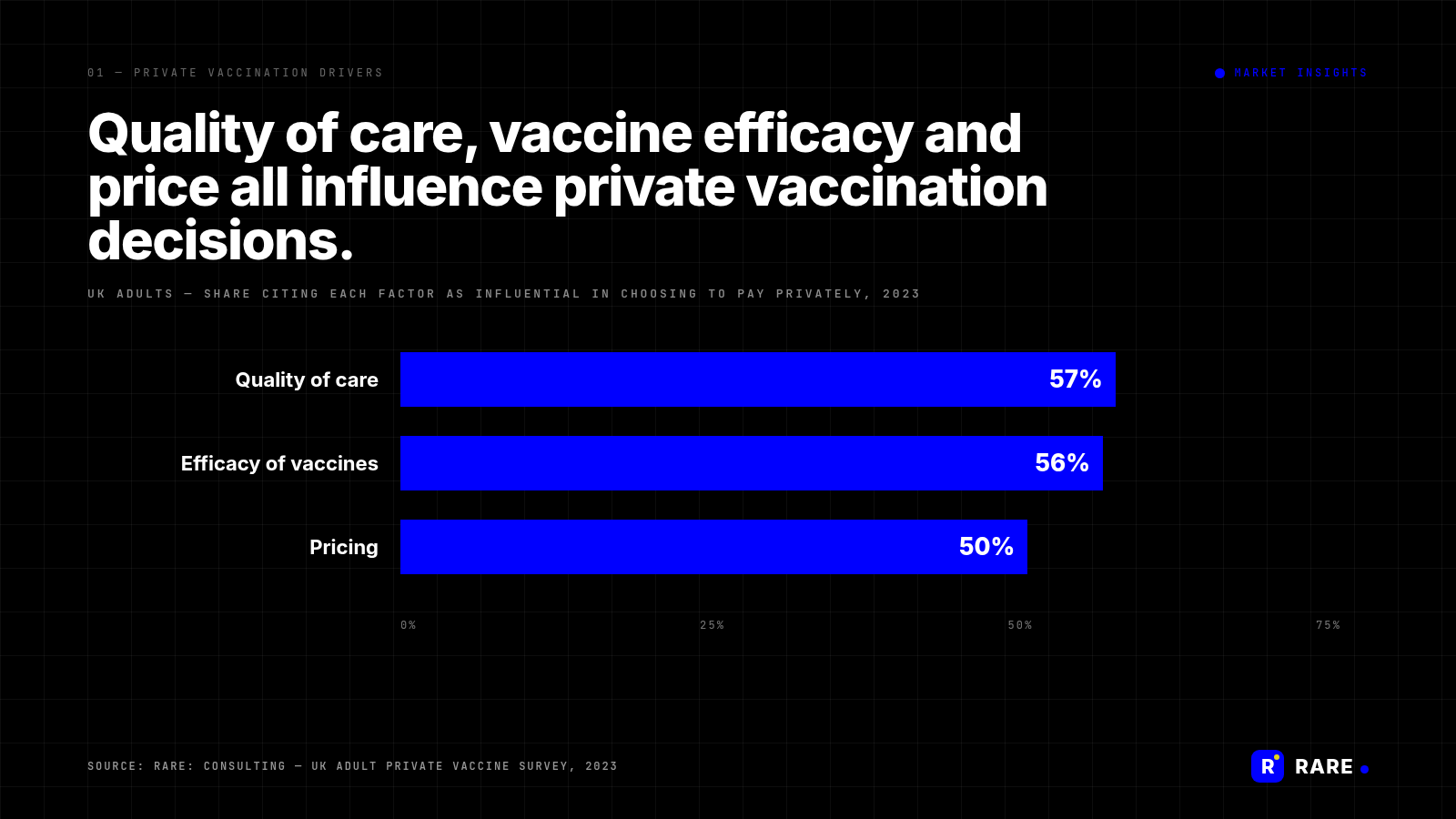
All three influences cluster within a 7-point range, meaning private vaccine providers cannot compete on a single dimension. Price-led messaging will not convert consumers who care equally about quality. Quality-led messaging will not convert price-sensitive consumers. The strongest commercial positions address all three concerns explicitly, ideally with cost transparency, clear efficacy claims supported by clinical evidence, and visible quality signals such as practitioner credentials and regulatory body registration.
Why are UK consumers getting vaccinated?
Behind the influence factors sit deeper consumer motivations. Safety concerns and personal health and wellness top the list of reasons UK adults give for considering private vaccination. The COVID-19 pandemic appears to have accelerated this prioritisation, with personal health management now sitting higher in UK consumer planning than it did pre-pandemic.
Where do UK consumers get vaccine information?
Despite the noise of the broader information environment, official sources remain dominant. 62% of UK adults use the NHS or government website as their main source of vaccination information. 30% turn to friends and family. Only 9% use social media platforms such as Instagram, Twitter or TikTok as a credible source.
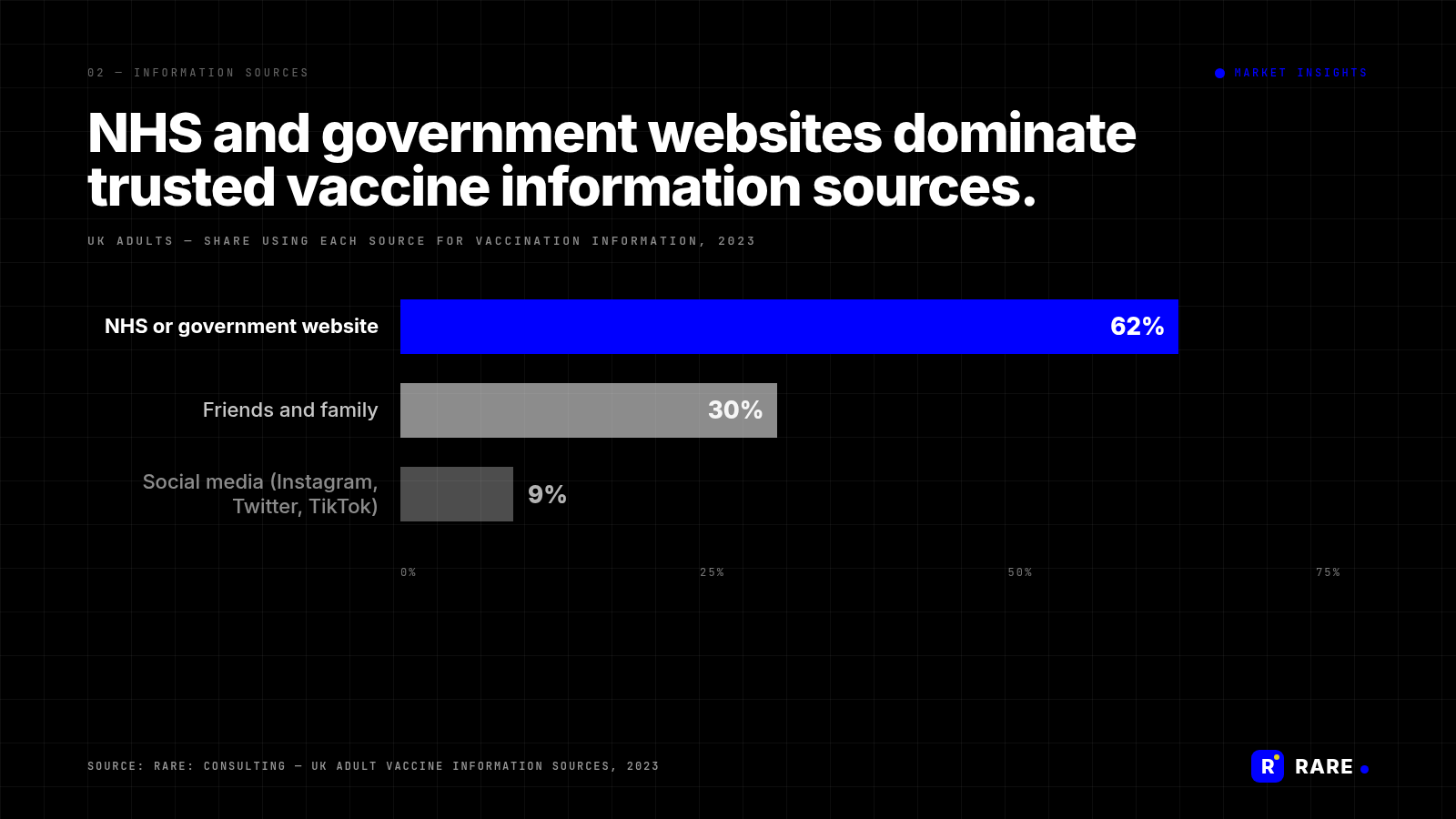
That distribution of trusted sources matters commercially. Manufacturers and private clinics that can secure prominent, credible coverage through NHS and government channels reach the UK consumer cohort considering private vaccination far more effectively than those that lean primarily on social media or paid digital advertising. Word-of-mouth among friends and family, the second-largest source, is harder to influence directly but reflects whether the patient experience itself is recommendable.
Quality, efficacy and price all sit within seven percentage points of each other in the UK consumer decision. That is unusually flat. Most private healthcare categories see one factor dominate, with the others playing supporting roles. UK private vaccination does not. Consumers are weighting the three near-equally, which means commercial messaging that wins on one axis and lets the others slide will leave conversion on the table.
The brands and providers that lead this category in the next two years will be the ones that handle all three explicitly: cost transparency on the booking page, clinical efficacy supported by evidence, and visible quality signals on the practitioner and clinic level. NHS website prominence remains the dominant trusted source, which makes secondary cross-channel listings on official UK health sources more valuable than premium consumer-marketing budgets do.