
A study of NHS dental deserts named Cornwall, East Lindsey, and King's Lynn and West Norfolk as England's worst-affected areas. Count private and mixed practices alongside NHS ones and those three sit in the second, third and fourth most rural-skewed regions. Wales ranks first.
Wales holds the most rural-skewed dental supply in Great Britain. Rare.'s analysis places the August 2026 British Dental Journal study of England's NHS dental deserts within a consistent comparison of England's regions, Scotland and Wales.
Rare. tracked confirmed dental locations across the United Kingdom in August 2026. The ranking below counts every provider type: NHS, private and mixed.
Wales has the highest rural share of dental locations
The British Dental Journal study discovered that, of the 189,542 individuals living in a deprived English dental desert, 97% live in rural areas. A quarter of the confirmed dental locations Rare.Monitor records in Wales sit in rural areas, the largest rural share of the eleven, but no equivalent NHS desert count exists for Wales at all.
Wales records the highest rural share of confirmed dental locations among the 11 regions compared. Rare.'s consistent provider base shows the scale of rural dental provision across England's regions, Scotland and Wales, while the study identifies how sharply access need falls on rural communities.
The next three regions hold the three named authorities
Cornwall, East Lindsey, and King's Lynn and West Norfolk are the three English local authorities identified as most affected. Their regions occupy ranks 2 to 4 for rural share of dental provision: South West, East of England and East Midlands in Rare.'s comparison of England's regions, Scotland and Wales.
Rare. counted NHS, private and mixed practices, and the ranking still holds
Rare.Monitor counts NHS, private and mixed dental locations on the same basis across England's regions, Scotland and Wales. Wales remains first on 25.5%, followed by the South West on 23.4%, the East of England on 17.9% and the East Midlands on 17.6%. Scotland ranked 8th, while London ranked 11th and last.
A wider account of the shape of the UK dental market shows how provider type and geography combine across dental provision.
Rank | Region | % rural |
|---|---|---|
1 | Wales | 25.5% |
2 | South West | 23.4% |
3 | East of England | 17.9% |
4 | East Midlands | 17.6% |
5 | Yorkshire and The Humber | 16.2% |
6 | South East | 15.8% |
7 | North East | 15.3% |
8 | Scotland | 14.8% |
9 | West Midlands | 11.1% |
10 | North West | 8.3% |
11 | London | 0.1% |
Northern Ireland is excluded because its separate rural and urban classification is not comparable with the Office for National Statistics system used here.
What this analysis covers
The 11-place ranking classifies dental locations by whether each is rural or urban; it does not measure residents' travel distance. It covers NHS, private and mixed practices across England's regions, Scotland and Wales, showing where dental provision is rural-skewed while excluding any practice absent from Rare.Monitor's coverage.
Independent data published by Senedd Research shows the same pattern: 25% of rural residents travel more than 5 miles to their nearest dental practice.
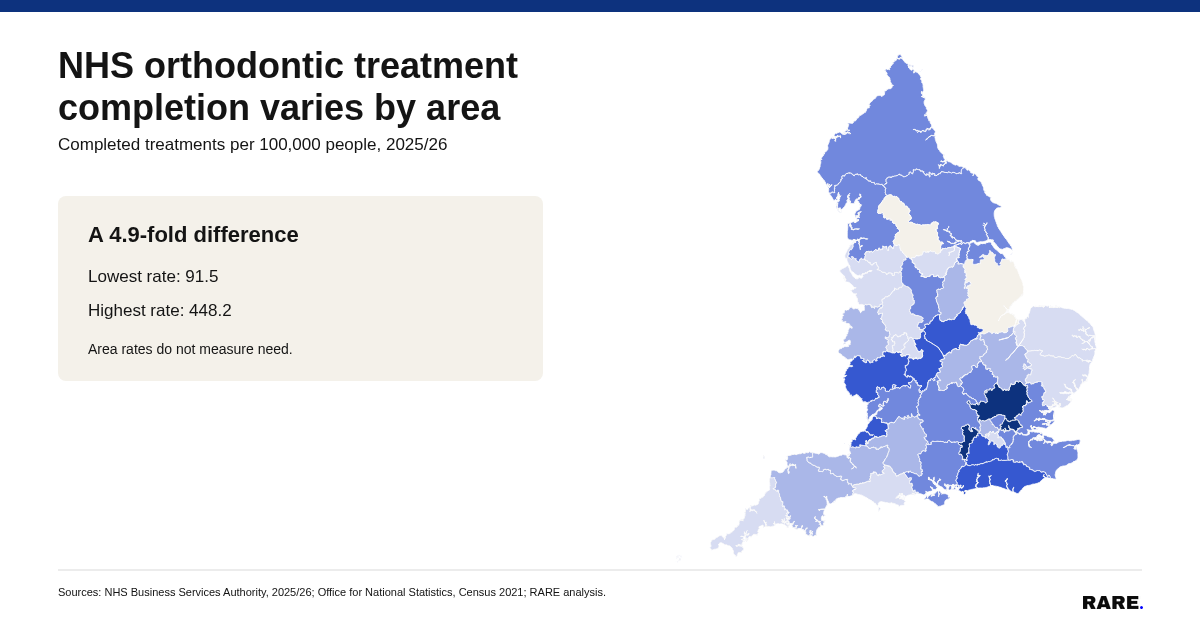
One earlier dental piece used the same coverage: NHS orthodontic completion against health deprivation.
For commissioners testing whether rural provision matches need, the first follow-up should be Wales, the South West, the East of England and the East Midlands, using resident travel distance and NHS capacity to show whether their rural-skewed supply translates into access.
Methodology: Rare.Monitor filtered 11,218 locations across the United Kingdom carrying a dentistry classification down to 6,202 confirmed dental locations. It kept locations Google classifies with a dental-specific service. Any location holding a pharmacist registration was treated as a pharmacy and excluded. Of 978 pharmacist-registered locations carrying a dentistry classification, none held a dental-specific type. The ranking uses the 5,970 of those that sit in Great Britain and carry both a region and a rural or urban classification. The study's 2.34 million and 189,542 figures come from a 5km distance calculation against lower-layer super output area (LSOA) centroids. Source study: Hugh Devlin, High-need dental deserts in England: a national spatial analysis of NHS access and deprivation, British Dental Journal 241, 191-194, August 2026. Source: Rare.Monitor, August 2026. Northern Ireland is not included in this ranking. The rural and urban classification used throughout this analysis is the Office for National Statistics system, which covers England, Scotland and Wales; Northern Ireland uses a separate classification system, so a comparable rural share could not be worked out for it here.