
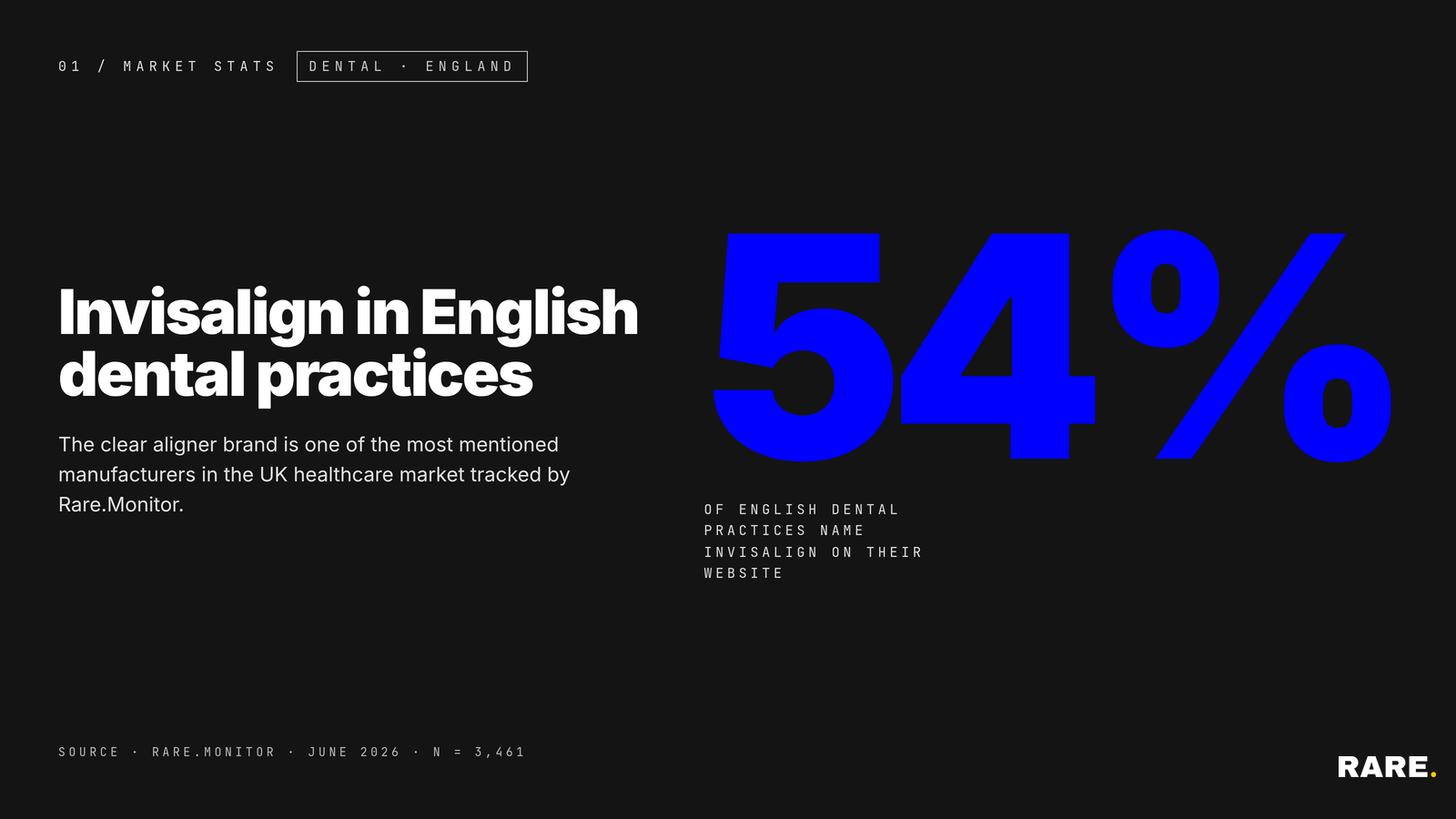
Invisalign in English dental practices, June 2026
June 2026 / Dentistry / UK
More analyses
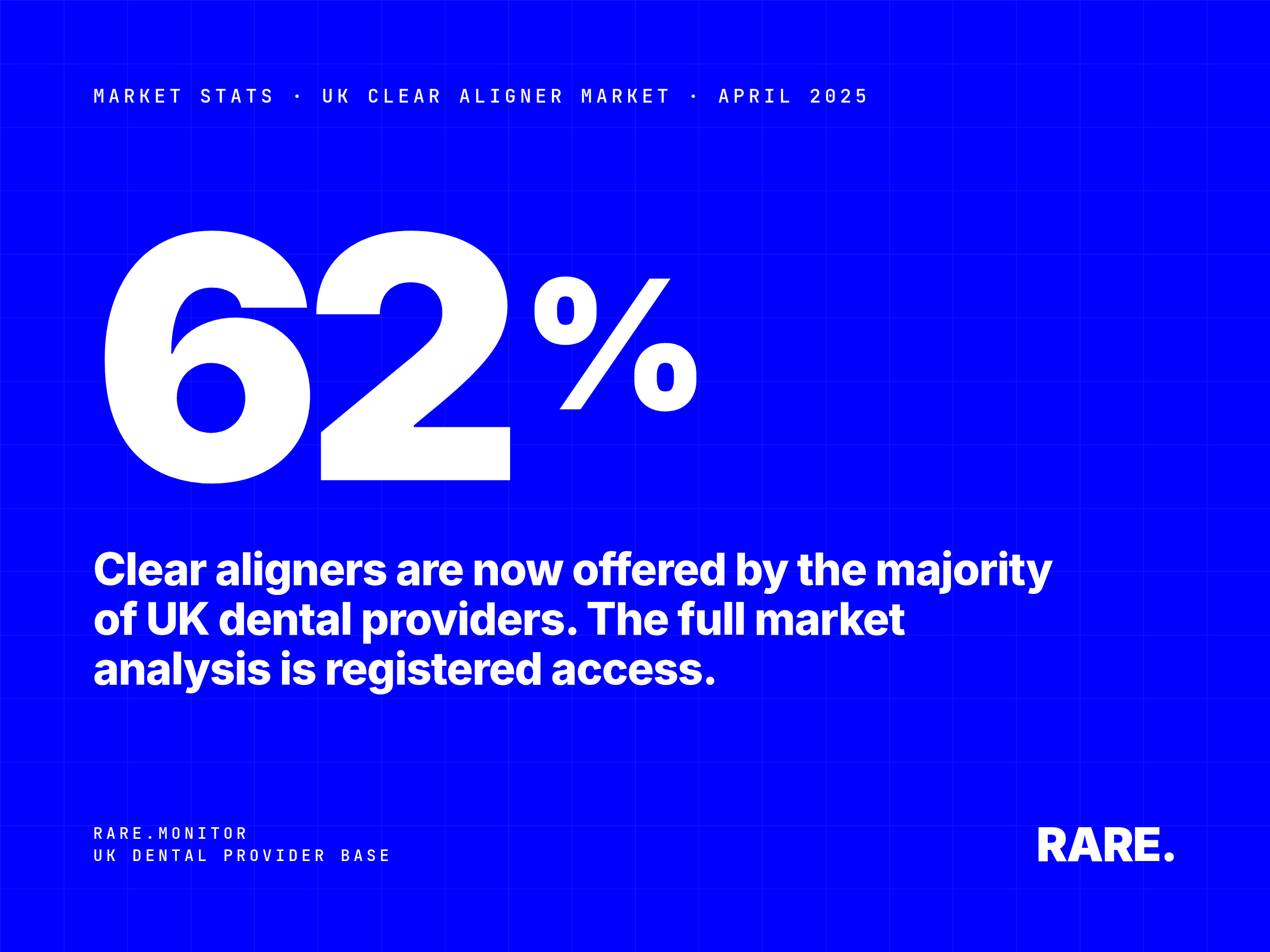
Clear aligner adoption in UK dentistry, April 2025
April 2025 / Dentistry / UK
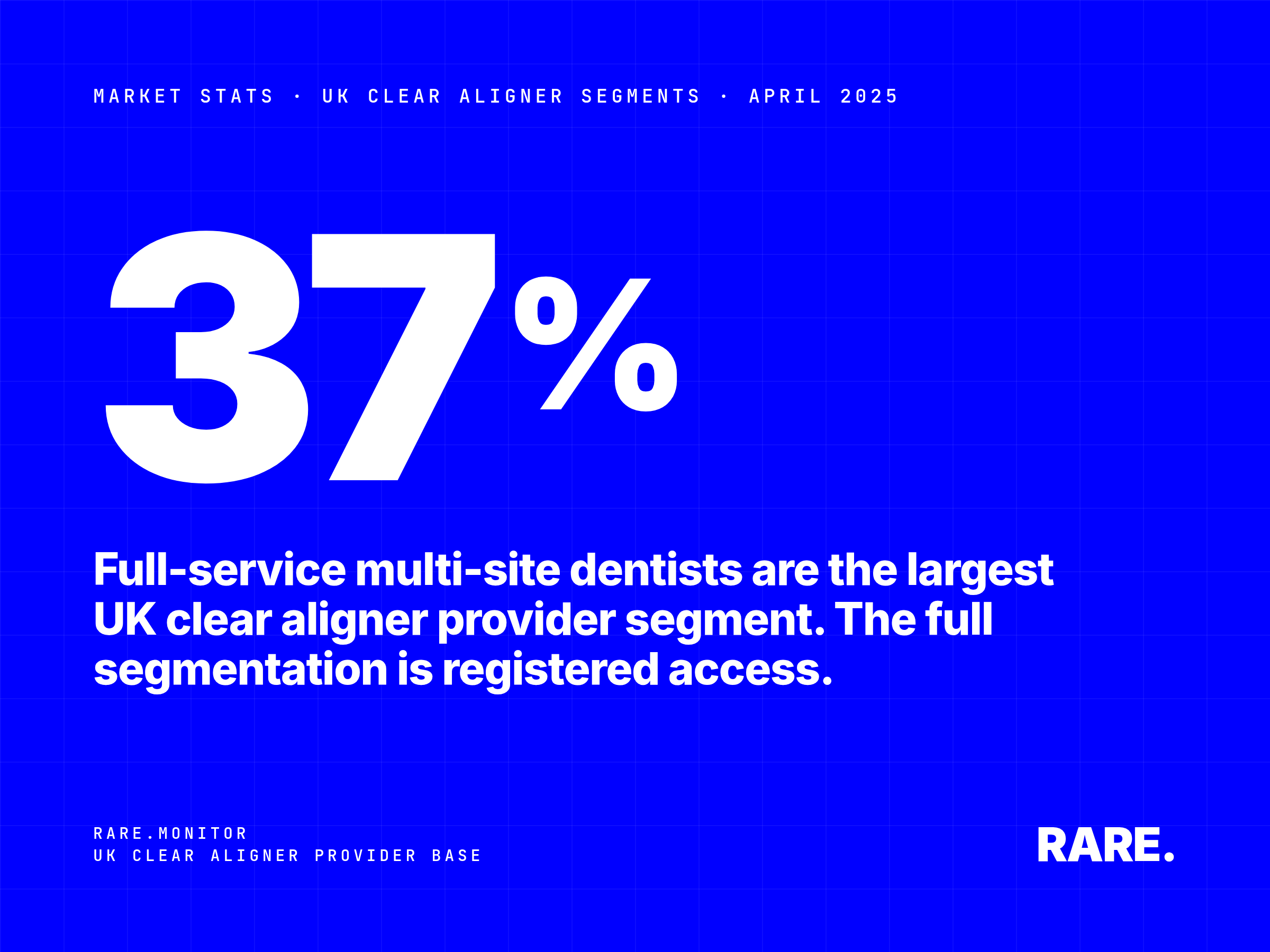
UK clear aligner clinics: four provider segments
April 2025 / Dentistry / UK
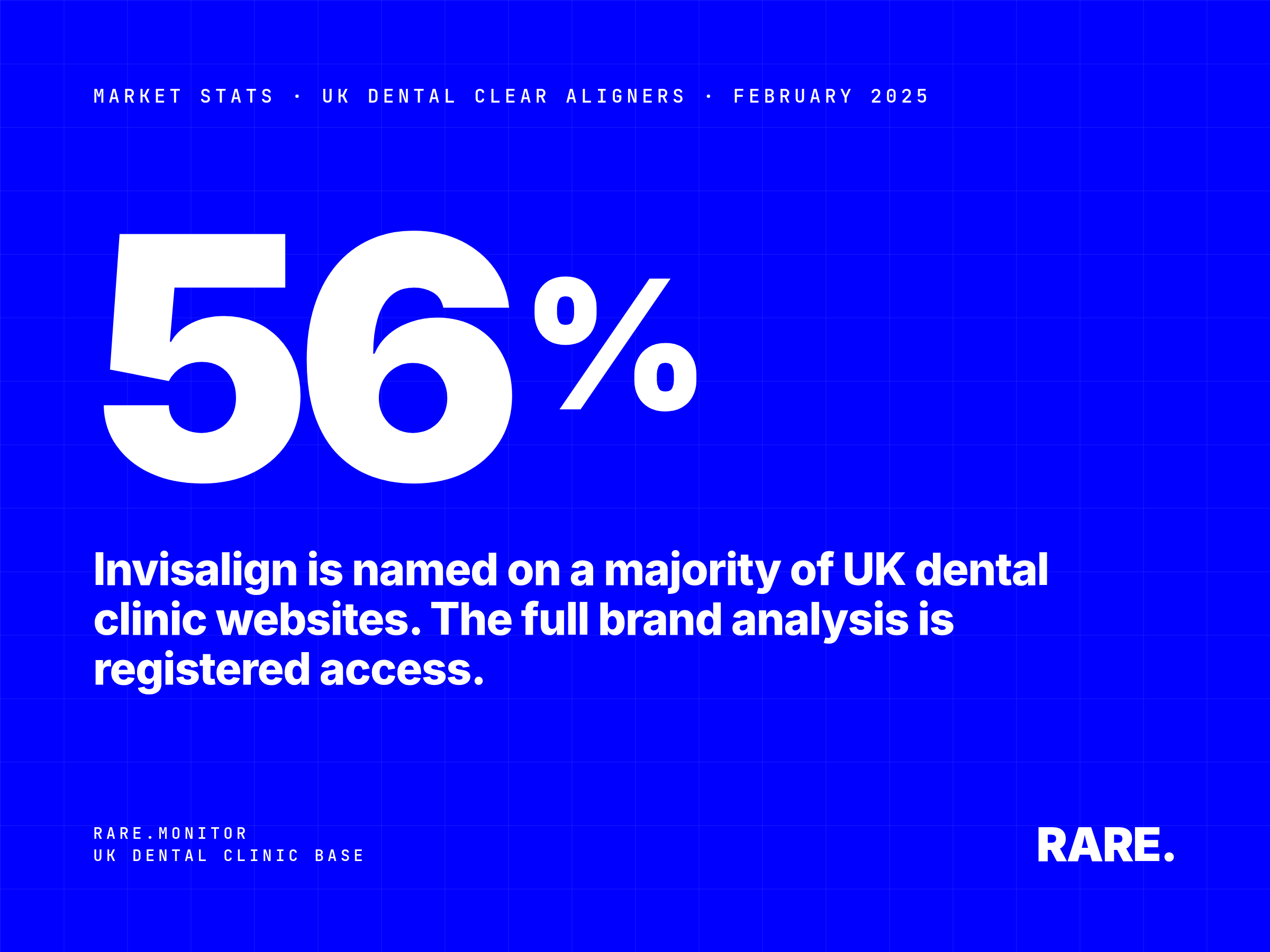
Which clear aligner brands UK dentists name, 2025
February 2025 / Dentistry / UK
About this market
Rare.Monitor records clear aligner provision at 5,773 UK locations, on figures read in August 2026, and the cohort resolves to 3,867 distinct owner records. Clear aligner therapy is orthodontic treatment. The British Orthodontic Society is the professional body for orthodontics in the UK, and the Irish Dental Association is the professional body for dentistry in the Republic of Ireland. This page holds the current figures for the segment and every analysis Rare. has published on it.
Roughly half of dentistry locations across the UK and Ireland offer clear aligners
Clear aligners have moved well beyond specialist orthodontic practice into mainstream general dentistry. In the UK, Rare.Monitor holds them at 5,619 dentistry-classified locations, 55.4% of the 10,140 UK dentistry locations it tracks on the same base. For manufacturers, distributors and commercial teams operating in this sector, that reach spans more than half the UK dental estate.
In the Republic of Ireland, Rare.Monitor records clear aligners at 423 locations. Of those, 406 are dentistry-classified, 49.0% of the 829 Republic of Ireland dentistry locations it tracks on the same base. Adoption in the Republic of Ireland runs a few points behind the UK, but clear aligners are still recorded at roughly half of the tracked dental estate.
In the UK, Invisalign is named at four in five locations, and ownership stays single-site
Invisalign appears on the published treatment listings of 4,560 of the 5,773 locations recording clear aligners, 79.0% of the cohort. The remaining one in five publish aligner treatment without naming it, and that is where a challenger brand's territory list starts.
The market is largely independent: 93% of the 3,867 owners in this cohort operate a single location. Concentration exists at the top of the table: 32 owners hold five or more locations, 15 hold ten or more, and the largest single owner holds 150. Covering this category means reaching thousands of separate independents, with a handful of groups worth a named account plan. The four provider segments across UK clear aligner clinics and which brands UK dentists name take those two questions further.
Adoption runs highest in London and the East Midlands
London records the highest clear aligner adoption of any UK region, at 62.3% of its dentistry locations, followed by the East Midlands on 61.5%, the North West on 58.9% and the East of England on 57.6%. All four sit above the 55.4% national rate.
Volume ranks differently. London holds 1,014 tracked locations and the South East 974, more than a third of the UK cohort between them, and the South East's adoption rate of 56.2% is barely above the national figure. The whitespace sits where adoption is lowest: the South West on 52.9%, the North East on 52.1% and Wales on 49.1%. In each of those three, more than four in ten dental locations publish no aligner treatment at all.
What the data is used for
Medtech companies use the location records to map treatment adoption across the dental estate and identify early-mover practices before committing to a commercial launch. Brand manufacturers track distribution at location level, benchmarking share against competitors and finding the regions where a product is absent. Private equity teams use the ownership data to understand market fragmentation and identify acquisition candidates. All three draw on the same location-level records, so a distribution plan and an acquisition shortlist come from one source.
2,249 of the clear aligner locations also record at least one medical aesthetics treatment, and 165 carry a dermatology classification. The medical aesthetics hub and dermatology hub cover the records held at those locations and across the wider estates.
FAQ
Frequently asked questions
Questions answered from Rare.Monitor data, figures read August 2026.
How many UK dental practices offer clear aligners?
Rare.Monitor records clear aligners at 5,617 UK dentistry-classified locations, 55.4% of the 10,140 UK dentistry-classified locations Rare.Monitor tracks, and at 5,771 UK locations in all. The tag is detected from what each location publishes about its own treatments, so the count records provision rather than measuring the whole market. Source: Rare.Monitor, figures read August 2026.Which clear aligner brand is named most often by UK dental practices?
Invisalign is the clear aligner brand Rare.Monitor detects most often, on a separate brand-detection read taken 3 August 2026. Of the 5,753 approved UK locations recording clear aligners on that read, 4,556 named Invisalign on their own website, a detection rate of 79.2%. Invisalign is the only aligner-specific brand currently in the Rare.Monitor brand catalogue, so this is a detection rate across that read's cohort and not a measure of market share. This is an earlier, separately dated pull, not restated against the August 2026 location and owner figures used elsewhere on this page. Source: Rare.Monitor, Invisalign detection read 3 August 2026.How is the UK clear aligner market structured by ownership?
Rare.Monitor links 4,883 of the 5,771 UK locations recording clear aligners to 3,867 distinct owner records. The remaining 888 locations carry no owner record and are excluded from the ownership concentration count. Of the matched owners, 3,598, or 93.0%, hold exactly one location. Source: Rare.Monitor, figures read August 2026.What does Rare.Monitor track in the clear aligner segment?
Rare.Monitor tracks treatment classifications, brand mentions and ownership links across 10,140 UK dentistry-classified locations, and more than 230,000 locations across the United Kingdom and Republic of Ireland (ROI). Records are built from what each location publishes about its own treatments and are refreshed on a rolling basis, so figures are restated on each new market read. Source: Rare.Monitor, UK dentistry figures read August 2026, platform figures read 4 August 2026.What is the difference between clear aligners and traditional braces?
Clear aligners are removable plastic trays that straighten teeth in stages without fixed metal brackets. Unlike traditional braces they are largely invisible when worn and can be taken out for eating and cleaning. In the UK they are widely available in general dental practice rather than only in specialist orthodontics: Rare.Monitor records them at 5,617 dentistry-classified locations, 55.4% of the 10,140 it tracks. Source: Rare.Monitor, figures read August 2026.
Methodology: Rare.Monitor is a private-market dataset, built on what each location publishes about its own treatments rather than on an official market survey, so a count records provision rather than measuring the whole market. Market figures on this page use the locked 26 August 2026 UK cut and the 27 August 2026 Republic of Ireland cut. Rare.Monitor records clear aligners at 5,773 approved UK locations, of which 5,619 also carry the dentistry classification; against the 10,140 UK dentistry-classified locations tracked, that gives the 55.4% share. The 3,867 distinct owner records cover 4,883 locations; 888 UK locations carry no owner record and are excluded from the ownership concentration count. In the Republic of Ireland, 406 of 423 clear aligner locations carry the dentistry classification, against 829 tracked dentistry locations. The Irish cohort is sourced mainly from Google Maps and ownership matching is incomplete, so its 49.0% adoption rate is a directional read and no Irish ownership claim is made. The clear aligner tag is detected from website text rather than confirmed by a regulator, and most UK records have not yet had a full treatment re-scrape, so the count does not represent every location offering the treatment. Platform-wide figures were read separately and are not comparable with the market figures above. Figures in the linked analyses below come from earlier snapshots measured on their own bases, so they are not a trend series with the figures on this page. Source: Rare.Monitor.