
The Medical Aesthetics industry is a complex marketplace that is always evolving. With new products and services available for patients, staying up-to-date on how the sector is changing from patient/consumer perspective is vitally important for HCOs (healthcare organisations), and HCPs (healthcare professionals).
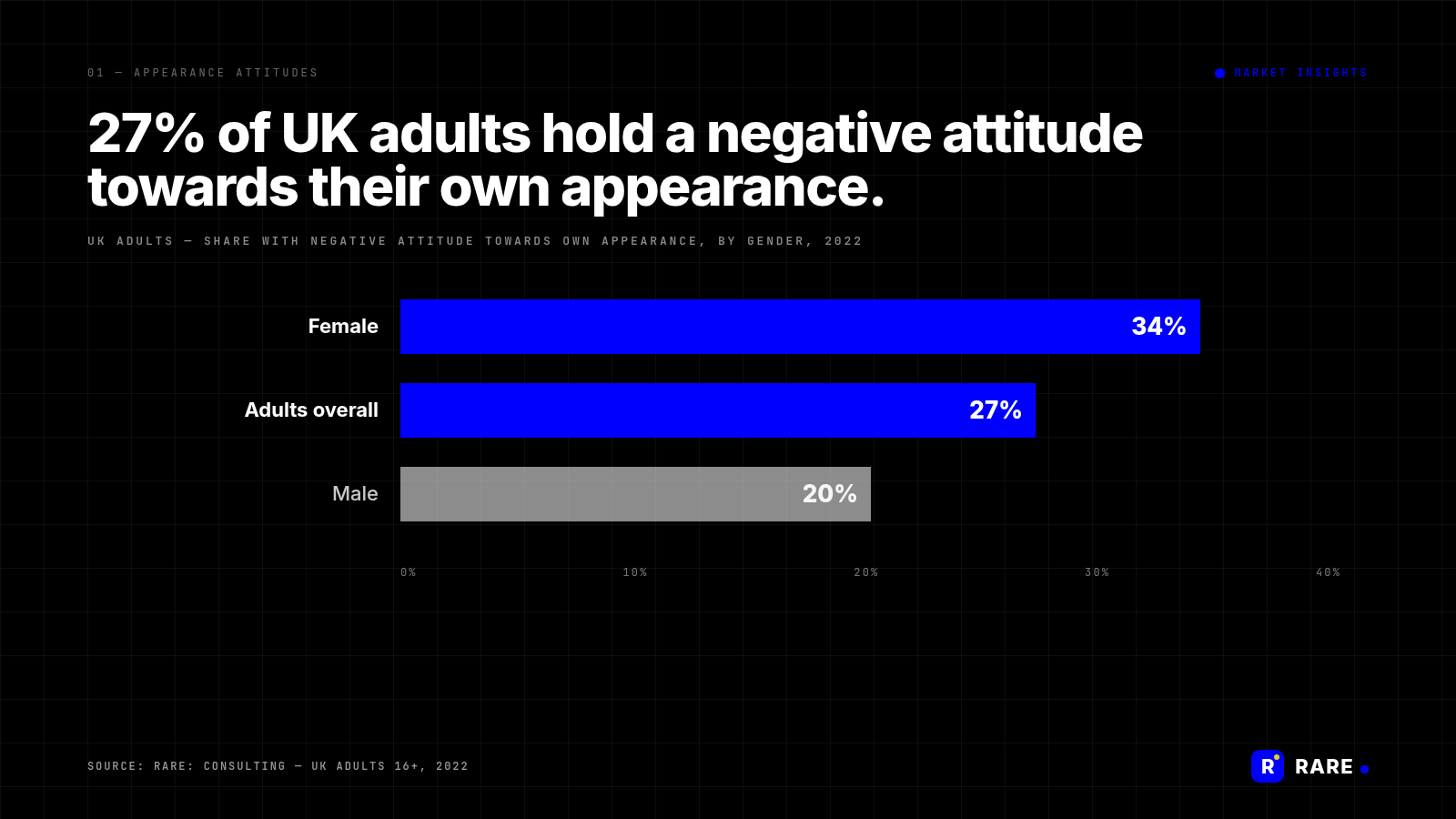
27% of UK adults hold a negative attitude towards their own appearance, rising to 34% among women, according to Rare. research from 2022. Around 7.92 million UK adults are either considering or have had aesthetic treatment in the past or next 12 months, and the UK non-surgical aesthetics market is on track to be worth more than £3 billion in the year ahead. The category continues to grow, but the drivers behind that growth are shifting in important ways.
How big is the UK aesthetics market?
UK demand for aesthetic treatment is now mainstream. Around 7.92 million UK adults are either considering or have had aesthetic treatment in the past or next 12 months. The UK non-surgical aesthetics market is on track to exceed £3 billion in the next 12 months, with botulinum toxin and dermal filler accounting for the bulk of that value. Medicated weight management and body contouring are the fastest-growing adjacent categories.
By age, 33-50 year olds are the largest group across all aesthetic treatments, followed by 25-32 year olds. The category is moving from a younger lifestyle purchase to a wider, longer-term consumer behaviour.
What is driving UK consumers to consider aesthetic treatment?
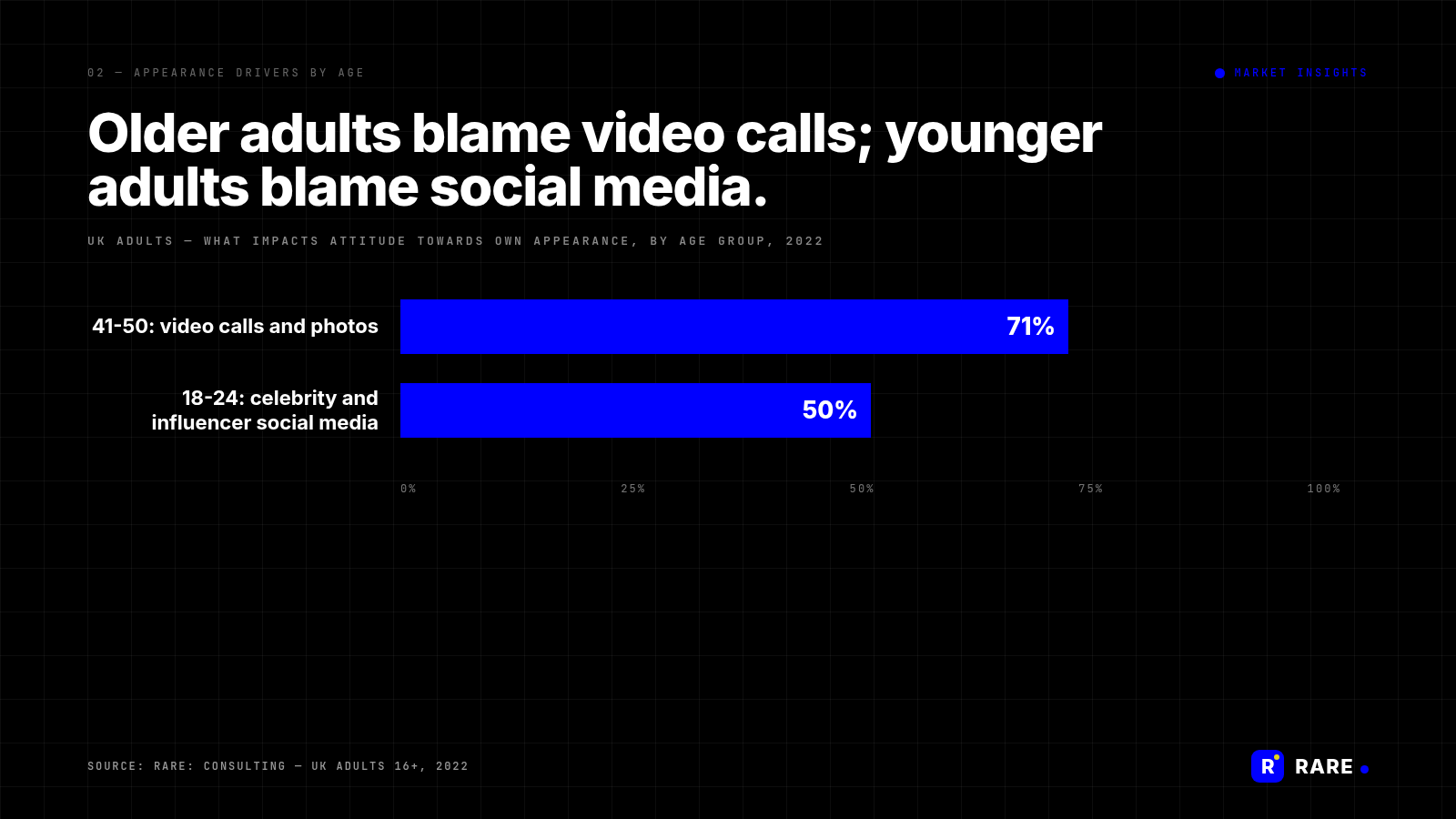
The drivers vary sharply by age group. 50% of 18-24 year olds say that looking at celebrity or influencer accounts on social media impacts their attitude towards their own appearance. 71% of 41-50 year olds say that seeing themselves in video calls and photos impacts their attitude. The same outcome, dissatisfaction with appearance, is being reached through entirely different routes.
For brand and clinic marketing, the implication is that messaging cannot be uniform across age groups. Younger audiences respond to social media-led narratives. Older audiences respond to lifestyle and remote-work-led narratives. The same campaign rarely lands well on both.
How does mental health affect aesthetic demand?
27% of UK adults overall, 34% of women and 20% of men, hold a negative attitude towards their own appearance. The youngest cohorts are the most affected: 37% of 16-17 year olds and 33% of 18-24 year olds report negative attitudes towards their appearance.
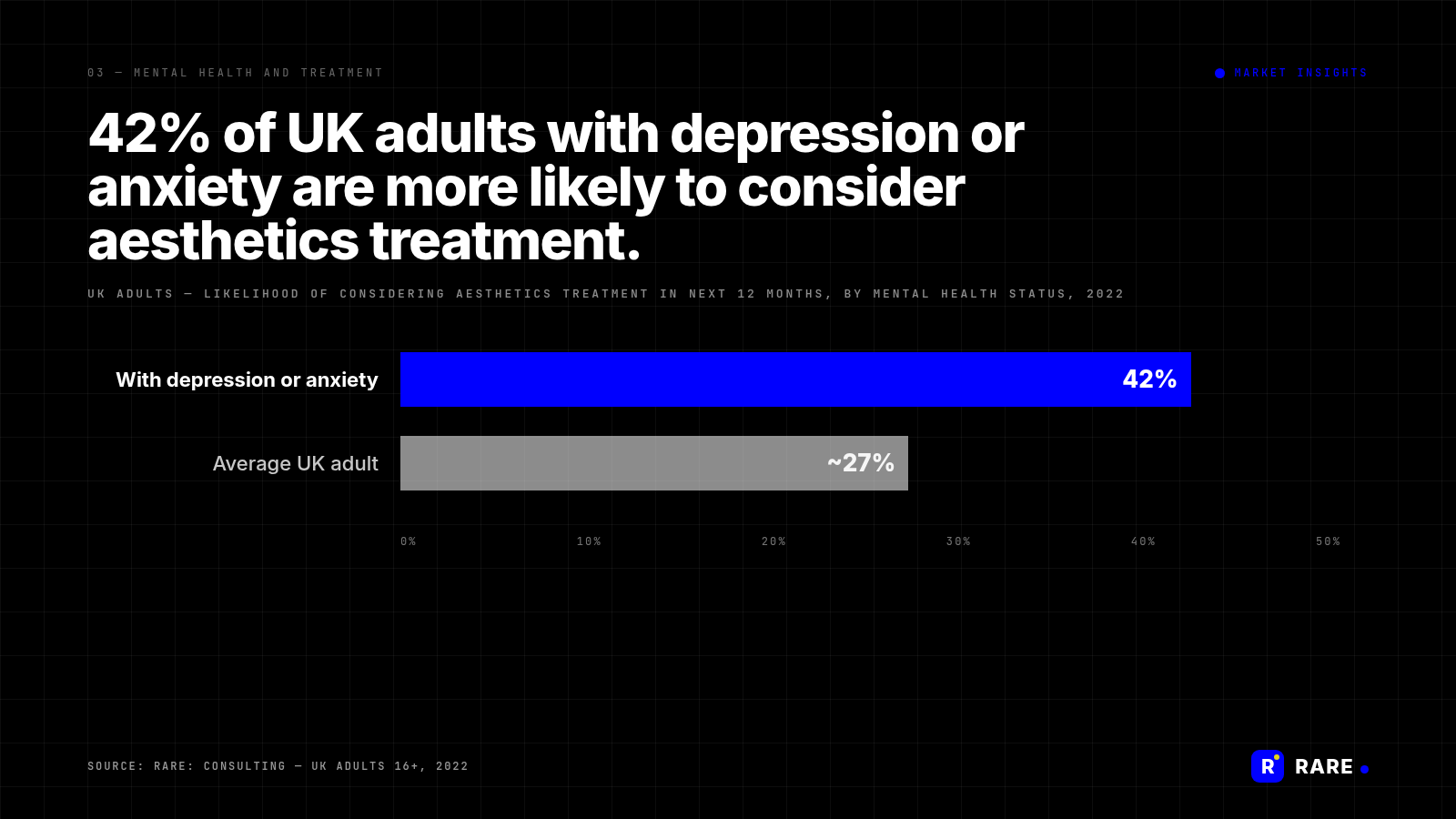
Mental health diagnoses correlate strongly with aesthetic treatment intent. 42% of UK adults with depression or anxiety are more likely than the average UK adult to consider aesthetic treatment in the next 12 months.
This places a duty of care on healthcare professionals at the consultation stage. Patients presenting with low body confidence and mental health context need to be supported with appropriate clinical pathways, not converted directly to treatment.
The drivers of dissatisfaction split sharply by age in a way that aesthetic marketing has not generally caught up with. Fifty percent of 18-24 year olds blame social media. Seventy-one percent of 41-50 year olds blame video calls. Same outcome, different routes, and a single campaign rarely lands well on both.
Aesthetic brands and clinics that treat the 16-50 audience as a single addressable market end up running narratives that read as wrong-targeted to one half and beside-the-point to the other. The brands that calibrate by age cohort, separate creative for under-35s built around social-media culture, separate creative for over-35s built around professional and remote-work appearance, will out-convert generic aesthetics marketing every time. Same products. Different stories.
Source: Rare. Medical Aesthetics Tracker, UK adults 16+, 2022.