
The UK medical aesthetics industry has been significantly growing over the years, with new products and treatments hitting the market regularly, the sector is always evolving in an attempt to keep up with demand. But what does that look like in terms of numbers?
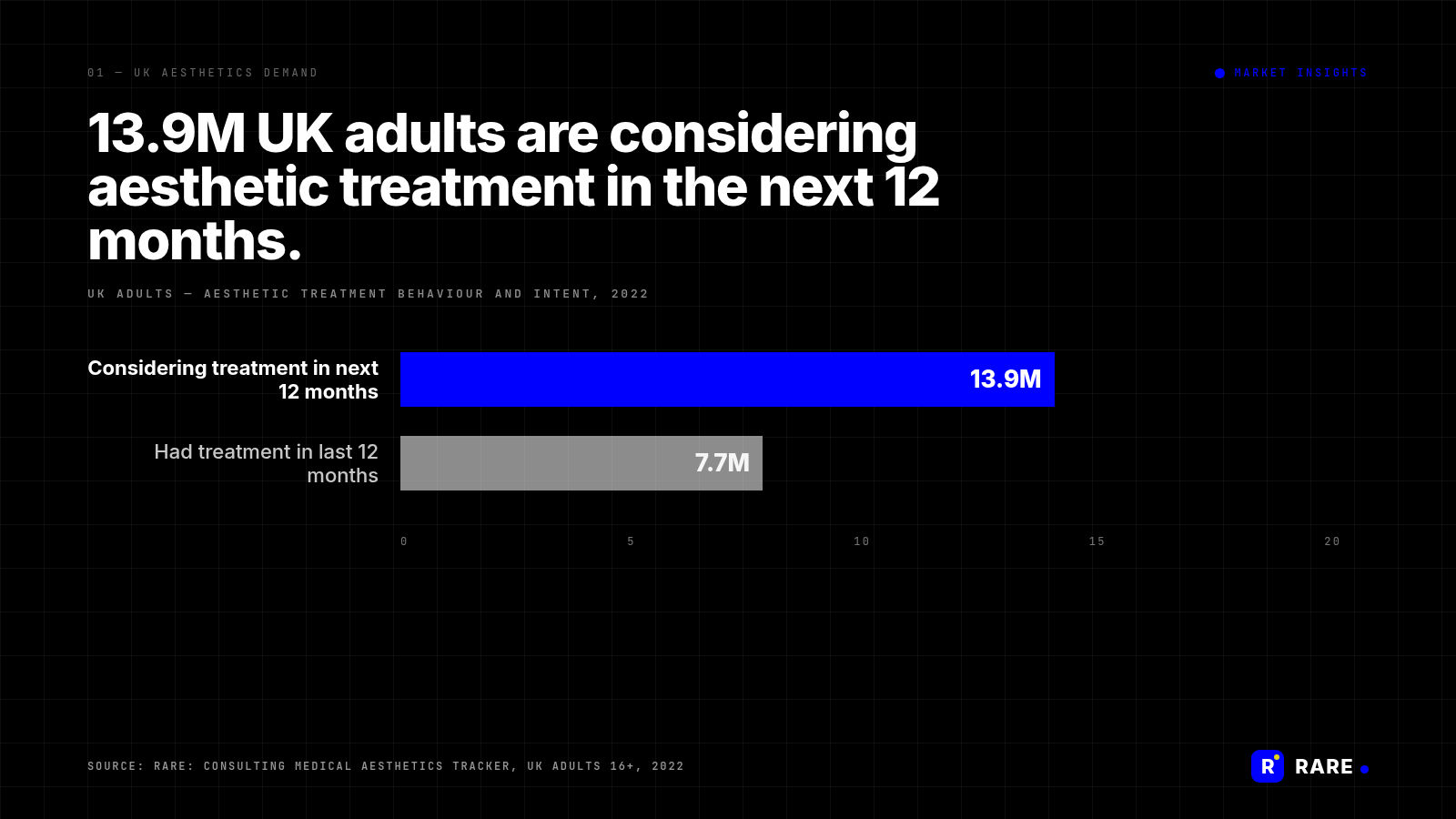
13.9 million UK adults are considering aesthetic treatment in the next 12 months, against 7.7 million who have had treatment in the past 12 months, according to Rare. tracker data from late 2022. The UK non-surgical aesthetics market is on track to exceed £3 billion in the year ahead, but the more interesting story sits in the gap between the two numbers: a six-million-strong cohort actively considering aesthetic treatment but not yet converted.
How is UK aesthetic demand splitting by age and treatment?
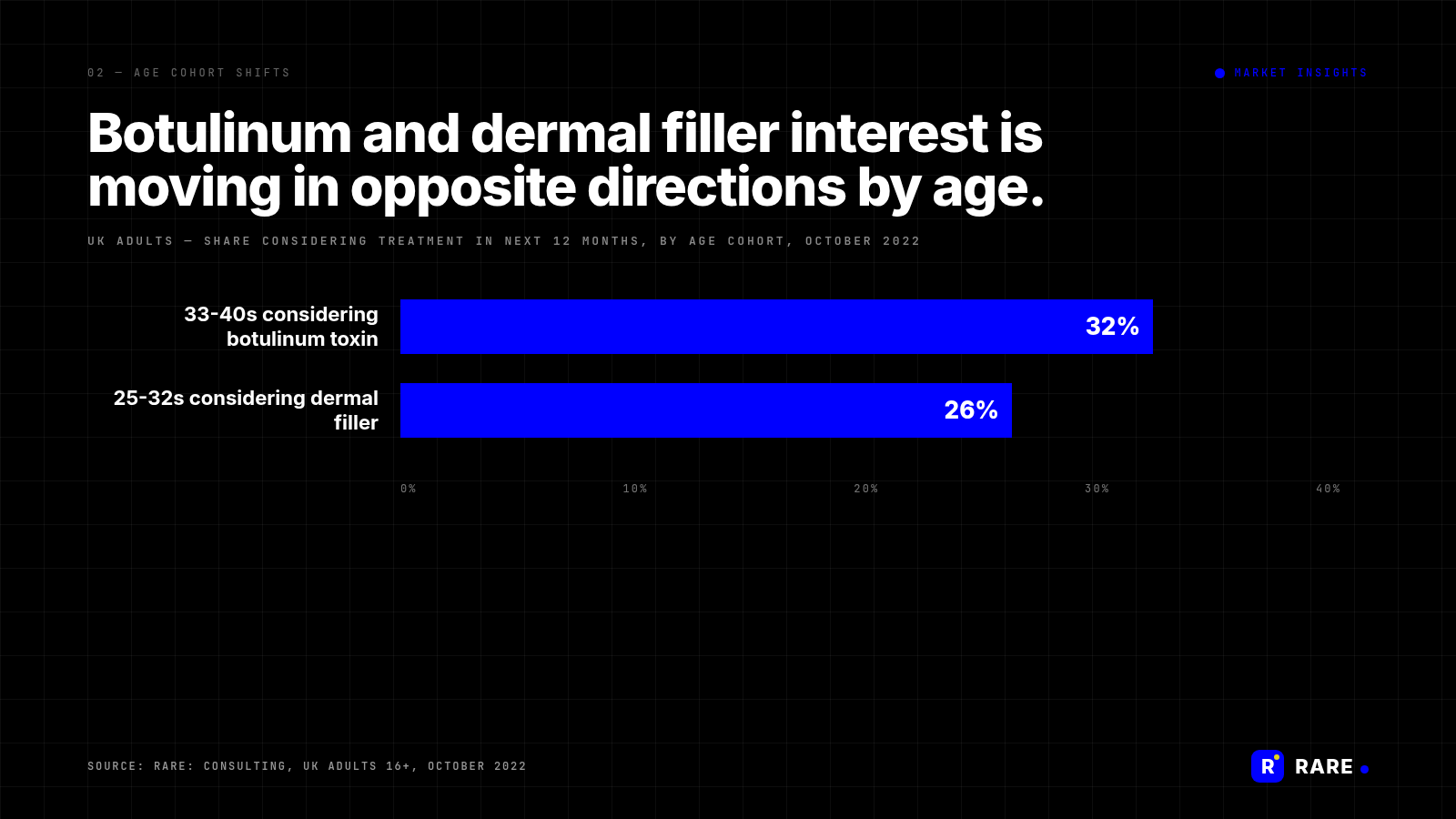
Botulinum toxin and dermal filler are now moving in opposite directions across age cohorts. Botulinum toxin demand grew 5% in six months, driven mainly by the 33 to 40 year old cohort, where 32% are now considering treatment in the next 12 months. The 25 to 32 year old cohort has gone the other way, with a 10% drop in botulinum toxin consideration over the same period.
Dermal filler is the mirror image. Growth came from the 25 to 32 cohort, where 26% are now considering the treatment, a 5 percentage point increase in six months, while the 33 to 40 cohort dropped 8 percentage points.
Regional variation maps onto the same divergence. London grew 4% in botulinum toxin consideration and 4% in dermal filler. The North East matched London on botulinum toxin. The West Midlands lost 2 points on botulinum toxin. Yorkshire and Humberside grew 5% on dermal filler. The South East lost 6 points on dermal filler.
Is UK supply meeting UK aesthetic demand?
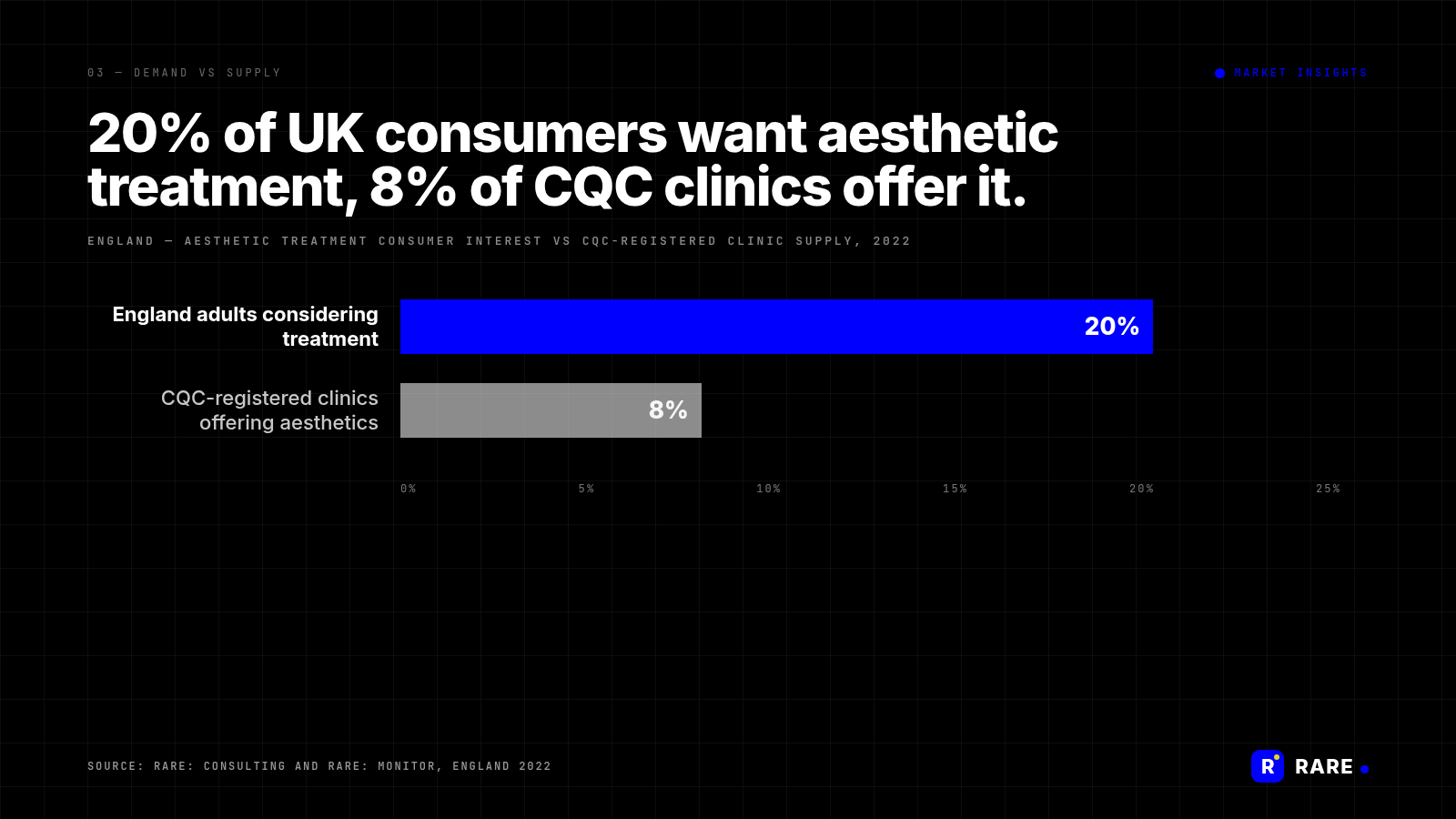
Across England, 20% of UK adults are considering some form of aesthetic treatment in the next 12 months. 8% of CQC-registered clinics offer aesthetic services. The two numbers are not directly comparable, since non-CQC-registered providers also serve the market, but the structural gap between consumer-side intent and clinical-aesthetic provider-side offering is wide enough to be visible in any reasonable adjustment.
Within the broader treatment mix, the gap inverts by treatment. Dermal filler appears overserved relative to current consumer demand. Botulinum toxin appears underserved relative to consumer demand. For commercial teams reading the data carefully, that distinction matters more than the headline market-size figure: the £3 billion market is not uniformly under-supplied, it has specific treatment categories where demand is running ahead of capacity and others where capacity is running ahead of demand.
The age-cohort divergence in injectable consideration is the more practically useful finding for marketing planners. A botulinum toxin campaign optimised for the 33 to 40 cohort, with separate creative for dermal filler aimed at 25 to 32, will out-convert any campaign that treats UK aesthetics as a single demographic block. Same products, different audiences, and different routes to each.
Source: Rare. Medical Aesthetics Tracker and Rare.Monitor, UK 2022.