According to Endometriosis UK, 1 in 10 women suffer with endometriosis, but receiving a diagnosis and treatment is challenging. Using Rare.Monitor data, we analysed registered locations in England that advertise treatments for gynaecological and pelvic floor dysfunction.
Fewer than a quarter of private gynaecology locations list endometriosis on their website
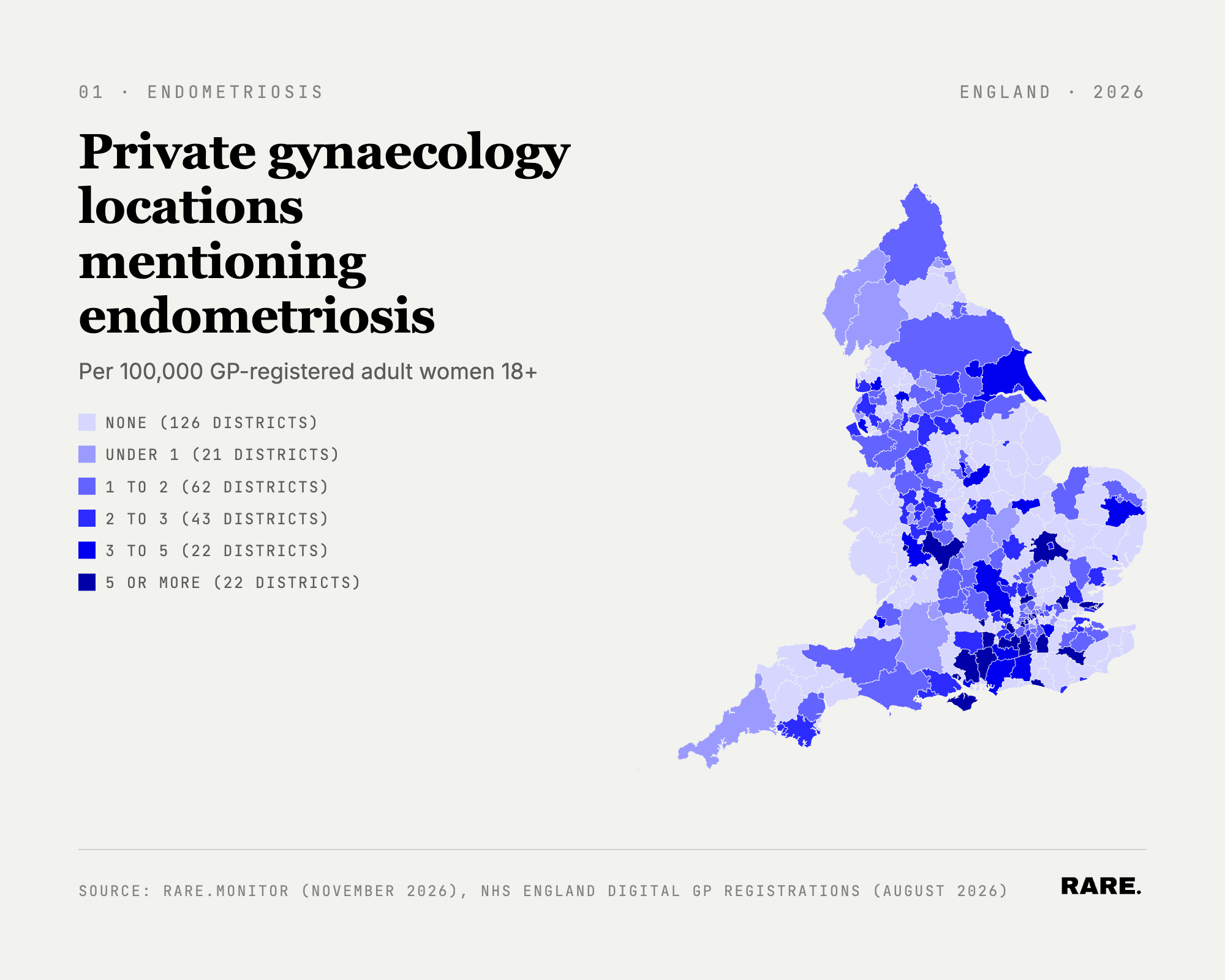
Across England, only 24% of private, registered gynaecology locations mention endometriosis on their website. Private Endometriosis provision is concentrated in London, most densely in Westminster. Half of Westminster's gynaecology locations mention endometriosis, which accounts for 11% of England's total endometriosis provision. For every 100,000 GP-registered adult women living in Westminster, there are 43.2 locations for endometriosis care. Outside of Westminster, the average number of these providers falls to just 1.6 per 100,000 women.
In 126 of England's 296 districts, which are home to around 8 million GP-registered women aged 18 and over, no private location lists endometriosis. Even when gynaecological care is available, endometriosis mentions are low; 34 districts have five or more private gynaecology locations but no advertised endometriosis care, including Stoke-on-Trent, County Durham and Canterbury.
What this means: London holds 26% of the private locations listing endometriosis, but is home to only 17% of England’s GP-registered women. Where local provision is scarce, some women are likely to travel to London for care. For those who live far from the capital, in areas with few local providers, that option may be out of reach.
Long NHS wait times are paired with limited private supply
In 39 districts, the NHS gynaecology wait times are higher than England's median of 14.4 weeks and private gynaecology supply is in the lowest quarter (4 or fewer locations per 100k women). About 2.3 million women aged 18 and over live in these districts.
Most of these districts are in the Midlands (18) and the East of England (11). Basildon has the longest wait among them, 18.7 weeks, with only two private gynaecology locations, neither of which list endometriosis care on their website. Lewes has a median wait of 17.8 weeks, with only one private location.
Almost 85% of the districts with wait times over the average have no mention of endometriosis on the websites of local private gynaecology care locations. Ten districts times have no analysable private gynaecology location at all, including Rutland, Fenland and Derbyshire Dales.
Where to go when London is out of reach
London is the most concentrated hub for private endometriosis care, but the capital is not easily accessible to everyone. The table below lists districts that show no endometriosis provision, paired with longer-than-average NHS wait time for gynaecological care. For each of these districts of residence, there is a corresponding district with some endometriosis awareness among gynaecology locations that are closer than London.
Region of residence | District of residence with no endometriosis mentions | Median NHS wait time | Closest district with 3+ locations mentioning endometriosis | Number of endometriosis aware locations per 100,000 GP-registered adult women |
|---|---|---|---|---|
Midlands | Tamworth | 16 | Walsall | 2.47 |
Midlands | North Kesteven | 17.4 | Peterborough | 3.14 |
Midlands | Charnwood | 15.1 | Leicester | 2.4 |
Midlands | West Lindsey | 17.4 | City of Kingston upon Hull | 1.24 |
Midlands | South Kesteven | 17.4 | Peterborough | 3.14 |
Midlands | Blaby | 15.1 | Leicester | 2.4 |
Midlands | Melton | 15.1 | Leicester | 2.4 |
Midlands | Rutland | 15.1 | Peterborough | 3.14 |
Midlands | Nuneaton and Bedworth | 16 | Solihull | 2.86 |
Midlands | Rugby | 16 | Stratford-on-Avon | 8.22 |
Midlands | Wyre Forest | 15.2 | Worcester | 6.62 |
Midlands | Chesterfield | 14.9 | Sheffield | 2.02 |
Midlands | Bolsover | 14.9 | Sheffield | 2.02 |
Midlands | Derby | 14.9 | Leicester | 2.4 |
Midlands | Derbyshire Dales | 14.9 | Sheffield | 2.02 |
Midlands | South Derbyshire | 14.9 | Leicester | 2.4 |
North West | Pendle | 14.8 | Preston | 4.65 |
North West | Burnley | 14.8 | Preston | 4.65 |
North West | Ribble Valley | 16 | Preston | 4.65 |
North West | Hyndburn | 14.8 | Preston | 4.65 |
East of England | Huntingdonshire | 16 | Peterborough | 3.14 |
East of England | East Cambridgeshire | 16 | South Cambridgeshire | 10.23 |
East of England | Fenland | 16 | Peterborough | 3.14 |
East of England | Tendring | 17 | Brentwood | 8.44 |
East of England | Babergh | 15.2 | South Cambridgeshire | 10.23 |
East of England | Great Yarmouth | 16 | South Cambridgeshire | 10.23 |
East of England | Breckland | 16 | South Cambridgeshire | 10.23 |
South East | Portsmouth | 16.5 | East Hampshire | 5.62 |
What this means: Endometriosis appears under-served in private gynaecology across England. Fewer than a quarter of gynaecology locations list it, and provision clusters in London and the South East. Across the Midlands and East of England, 39 districts combine long NHS waits with thin private supply, and most have no mention of endometriosis at all. For locations already offering gynaecology in these areas, adding advertised endometriosis care could meet demand from those who currently have to travel for care.
Key findings
Fewer than a quarter of England’s private gynaecology providers list endometriosis, and provision is concentrated in London, which has 26% of endometriosis providers but 17% of GP-registered adult women. Westminster alone accounts for 11%. In 126 of England’s 296 districts, home to around 8.2 million women, no private location lists endometriosis, including 34 districts with established private gynaecology markets. In 39 districts, mostly in the Midlands and East of England, long NHS waits meet thin private supply, and 33 of these have no endometriosis provider at all.
Methodology
Clinic data comes from Rare.Monitor, covering 1,877 registered private locations in England [November 2026] that mention treatments for gynaecological and pelvic floor treatments, excluding pharmacies. 'Endometriosis providers' list endometriosis among their treatments. Locations are matched to local authority districts via postcode. NHS waits are 12-month median gynaecology waits from NHS England referral to treatment data (September 2025 to August 2026), published by sub-ICB and assigned to the districts each sub-ICB covers. Population is GP-registered women aged 18 and over (NHS Digital England, [August 2026]), published by sub-ICB and split across districts by share of LSOAs. All figures are reported for England’s 296 local authority districts.