
Dentists have become more than just a place you go to for dental treatment. They are now becoming increasingly recognised as a place to go for all your aesthetic needs, as we’ve started to see this trend grow in recent years.
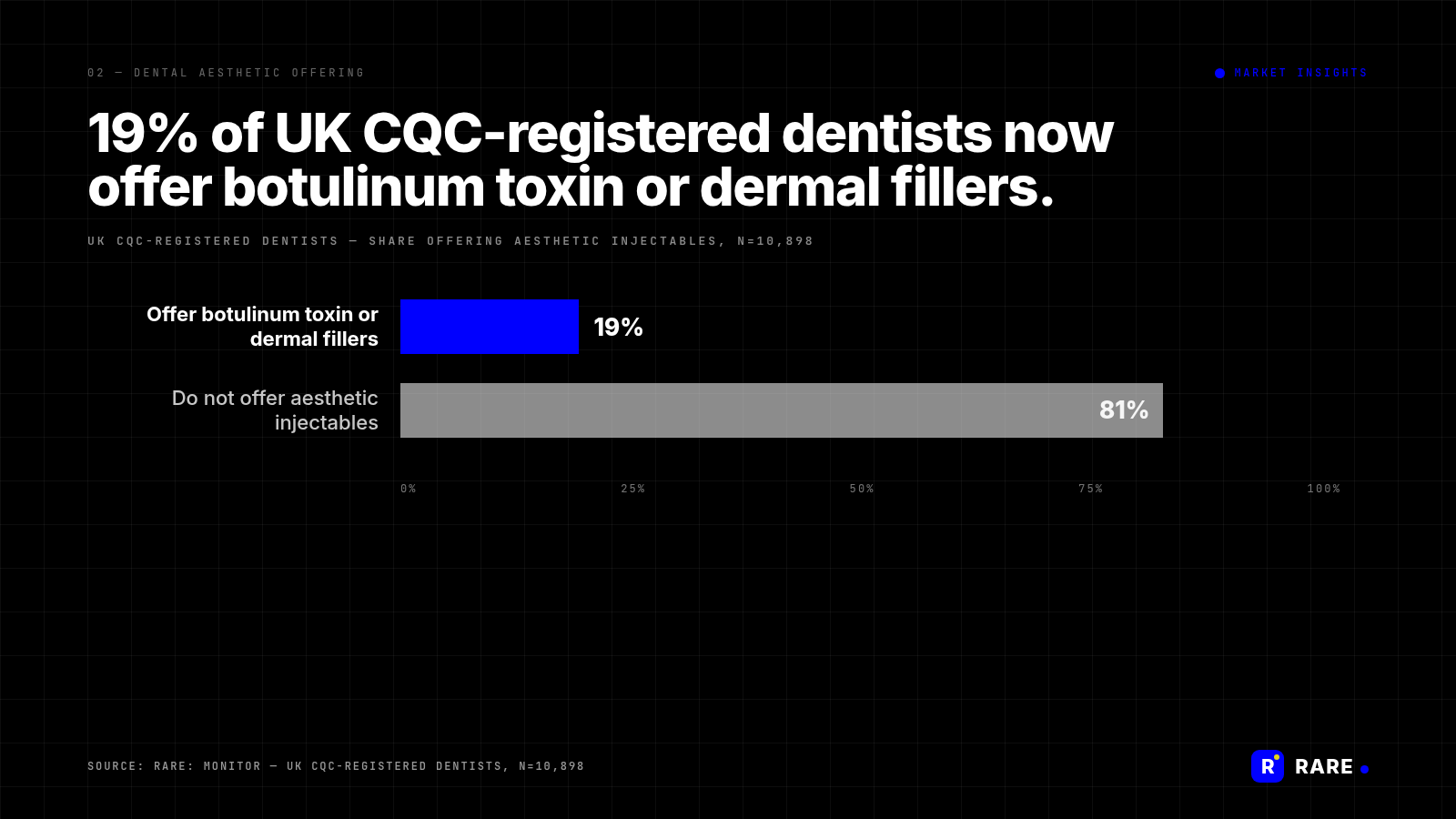
19% of UK CQC-registered dentists now offer botulinum toxin or dermal filler, yet only 6% of UK consumers who had botulinum toxin in the past 12 months received it at a dental practice, according to Rare.Monitor data tracked across 10,898 CQC-registered UK dentists. Aesthetic dentistry is a fast-growing dental sub-segment, but consumer awareness has not caught up with provider availability. The gap is the clearest growth opportunity in the category.
What is aesthetic dentistry?
UK dentistry has expanded beyond traditional dental treatment into facial aesthetics. Cosmetic dentistry, the long-established term, refers to procedures that enhance the appearance of teeth and smile, including teeth whitening, dental bonding and veneers. Aesthetic dentistry now extends that scope to facial injectables such as botulinum toxin and dermal filler.
The distinction matters commercially. Cosmetic dentistry stays inside the mouth. Aesthetic dentistry extends into the wider face. Dentists are uniquely qualified to offer the latter because they understand facial anatomy as well as any aesthetic practitioner, and arguably better than non-clinical providers operating in beauty settings.
Why does dental aesthetic delivery matter for patient safety?
UK dental practices are CQC-registered, which means they already operate under structured regulatory oversight on staff qualifications, facility safety, complaints handling and informed consent. For patients, that registration is a meaningful safety signal that non-clinical aesthetic providers do not always carry. Dentists administering injectables sit inside a regulated clinical environment by default.
How established is aesthetic dentistry across UK dental practices?
19% of CQC-registered UK dentists now offer botulinum toxin or dermal filler. That is roughly 2,070 dental practices out of 10,898 tracked by Rare.Monitor.
Botulinum toxin has long been used by dentists to treat clinical issues including bruxism and TMJ disorders. The expansion into cosmetic facial use is a natural extension of existing clinical capability, not a new departure. As consumer demand for facial injectables has grown, dental practices have adapted faster than the wider market expected.
Where do UK consumers actually receive their aesthetic treatments?
Despite the growing supply of aesthetic-trained dentists, UK consumer behaviour still routes overwhelmingly to aesthetic clinics. 60% of UK consumers who had botulinum toxin in the past 12 months received it at an aesthetic clinic. 8% received it at a beauty salon or spa. Only 6% received it at a dental practice.
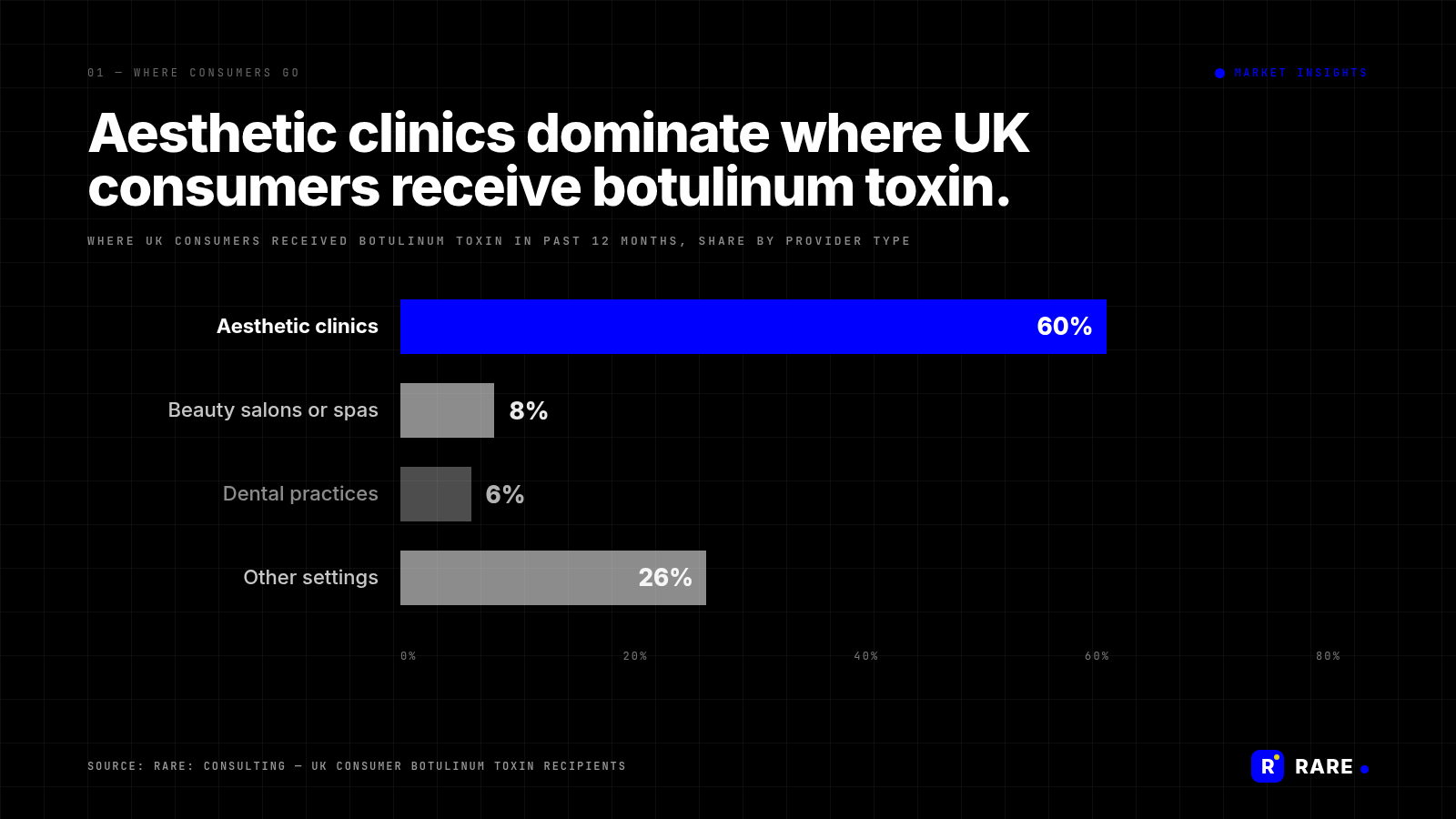
That split is striking. Beauty salons and spas, which typically operate without the clinical regulation that CQC-registered dental practices carry, are taking more consumer botulinum toxin volume than dentists. The likely explanation is brand awareness rather than capability or safety. Most UK consumers do not associate dentistry with facial injectables, and dental practices have not yet invested in marketing that shifts that perception.
The strangest finding in this analysis is the eight percent. Beauty salons and spas, which mostly do not carry CQC registration and operate without the regulatory framework UK dental practices live inside by default, take a higher share of UK consumer botulinum toxin volume than dental practices do. Six percent versus eight. A safer, more clinically qualified channel losing to a less safe one.
That is not a clinical problem. The dental practices have the qualifications. It is a brand awareness problem. UK consumers do not associate dentistry with facial injectables, so they default to the channels they recognise from social media and consumer marketing. Dental practices that invest visibly in aesthetic marketing, before-and-after content, consumer reviews, and visible facial-injectable positioning, could plausibly capture the eight percent currently going to beauty salons faster than they could capture the sixty percent going to dedicated aesthetic clinics. The eight percent is the easier conversion. It just needs to be told the dentist offers the service.
Source: Rare.Monitor, n=10,898 UK CQC-registered dentists.